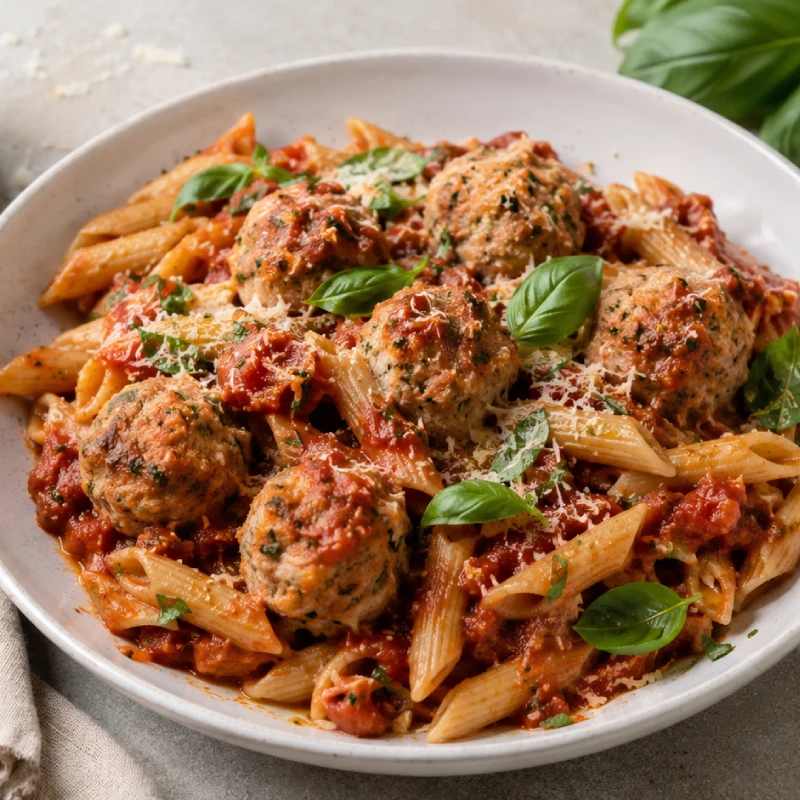
A bowl of meatballs and pasta is the kind of dinner that feels comforting before you have even taken the first bite. Warm tomato sauce, tender meatballs, fresh basil and pasta are familiar, cosy flavours — and following a Low FODMAP Diet should not mean giving meals like this up.
These Low FODMAP turkey meatballs with tomato basil sauce and gluten-free pasta have been designed to give you that classic comfort-food feeling while also creating a genuinely balanced meal.
Each serving is designed to provide at least 30 g of protein and around 10 g or more of fibre, with plenty of vegetables, a sensible portion of gluten-free whole-grain pasta and lean turkey meatballs.
The proportions are inspired by the Harvard Healthy Eating Plate: approximately half the meal comes from vegetables, one quarter from a quality protein source and one quarter from a whole-grain carbohydrate.
And although classic meatball recipes often rely heavily on onion and garlic, we do not need either of them here.
Garlic-infused olive oil, fresh basil, oregano, chives, tomato and a little Parmesan create a rich, savoury sauce without making the ingredient list complicated.
If you have IBS, bloating or are currently following a Low FODMAP plan, this is exactly the sort of recipe worth saving: familiar, filling, meal-prep friendly and easy enough for a beginner cook.
Table of Contents
Why You’ll Love These Low FODMAP Turkey Meatballs
One of the hardest things about starting a Low FODMAP Diet can be looking at your favourite recipes and suddenly spotting onion and garlic everywhere.
Pasta sauce? Garlic.
Meatballs? Onion and garlic.
Seasoning mix? Usually garlic powder, onion powder or both.
It can make a very ordinary dinner seem unnecessarily complicated.
This recipe takes a different approach. Rather than trying to recreate every ingredient exactly, we keep the flavours that make the meal satisfying and replace the ingredients that are more problematic.
You still get juicy meatballs.
You still get a rich tomato and basil sauce.
You still get pasta.
But you also get a much more balanced plate, with enough vegetables and fibre to turn traditional meatballs and pasta into a complete meal.
A High-Protein Low FODMAP Dinner
The turkey meatballs are the main protein source.
Using approximately 150 g raw lean turkey mince per person means each serving is designed to comfortably exceed 30 g of protein once the contributions from the pasta and other ingredients are included.
Protein is useful for satiety, muscle maintenance and many essential processes throughout the body. But there is no need to make half your plate meat to reach a good protein intake.
That is one of the advantages of structuring the meal around the Harvard plate principles: the turkey takes up roughly one quarter of the plate, while vegetables get much more space.
At Least 10 g of Fibre Per Serving
The fibre target requires slightly more thought.
Traditional gluten-free pasta dishes can sometimes be surprisingly low in fibre, especially if the pasta is made predominantly from refined rice or corn flour and the sauce contains very few vegetables.
Here, fibre comes from several places:
- carrots;
- courgette;
- baby spinach;
- green beans;
- tomato;
- gluten-free whole-grain pasta;
- a small quantity of oats in the meatballs.
Together, these ingredients are designed to bring each serving to approximately 10 g of fibre or more.
That distribution is deliberate.
Rather than adding a huge portion of one high-fibre food — which may not feel comfortable for a sensitive gut — we obtain smaller amounts from several different ingredients.
How This Recipe Follows the Harvard Healthy Eating Plate
The Harvard Healthy Eating Plate is a useful visual tool because it shifts the focus away from counting individual ingredients and towards the overall composition of a meal.
The general structure is:
- ½ the plate: vegetables and fruit;
- ¼ of the plate: healthy protein;
- ¼ of the plate: whole grains;
- plus healthy plant oils and water.
For this Low FODMAP turkey meatball pasta, we can use almost exactly the same structure.
Half the Plate: Vegetables
This is where our tomato sauce does some very useful work.
Instead of making a sauce that is mostly tomato with a couple of herbs, we include:
- grated carrot;
- courgette;
- baby spinach;
- tomato.
We then serve green beans alongside the pasta.
Altogether, that gives each person a generous quantity of vegetables without requiring an enormous bowl of salad on the side.
One Quarter: Turkey Meatballs
Lean turkey provides the protein portion.
Turkey itself does not contain FODMAP carbohydrates, but the ingredients commonly mixed into meatballs often do. So our homemade version avoids chopped onion and garlic and uses Low FODMAP flavourings instead.
One Quarter: Gluten-Free Whole-Grain Pasta
Gluten-free does not automatically mean high fibre.
For this recipe, look for a brown rice, quinoa or other whole-grain gluten-free pasta if available.
A whole-grain version will usually provide more fibre than a highly refined gluten-free pasta and fits the Harvard plate concept more closely.
If the pasta available to you is lower in fibre, the recipe still provides plenty from the vegetables, but choosing a product containing at least around 5–6 g fibre per 100 g dry pasta makes reaching the 10 g target easier.
Turkey Meatballs with Tomato Basil Sauce and Gluten-Free Pasta
Serves: 4
Prep time: 20 minutes
Cooking time: 30–35 minutes
Total time: approximately 50 minutes
Difficulty: Easy
Meal prep friendly: Yes
Ingredients
For the Low FODMAP turkey meatballs
- 600 g lean turkey mince, ideally around 5% fat
- 1 large egg
- 40 g certified gluten-free rolled oats, briefly blitzed or finely crushed
- 2 tablespoons finely chopped fresh chives
- 2 tablespoons chopped fresh parsley
- 1 teaspoon dried oregano
- 1 teaspoon smoked paprika
- ½ teaspoon salt
- Freshly ground black pepper
- 1 tablespoon garlic-infused extra-virgin olive oil, plus a little extra for cooking
For the tomato basil vegetable sauce
- 400 g canned chopped tomatoes
- 200 g carrots, finely grated
- 260 g courgette (zucchini), finely diced
- 200 g baby spinach
- 2 tablespoons garlic-infused extra-virgin olive oil
- 1 teaspoon dried oregano
- 1 teaspoon smoked paprika
- ½ teaspoon salt
- Freshly ground black pepper
- Large handful fresh basil, roughly torn
- 100–150 ml water, as needed
For the pasta and vegetables
- 300 g dry gluten-free whole-grain pasta, approximately 75 g per serving
- 300 g green beans, trimmed
- 200 g additional carrots, sliced into thin batons or ribbons
- 1 tablespoon extra-virgin olive oil
- Fresh lemon juice, optional
- Salt and black pepper
Optional toppings
- Fresh basil
- Chopped chives
- Finely grated Parmesan, according to individual tolerance
- Chilli flakes, if tolerated
- Garlic-infused olive oil
- Freshly ground black pepper
Important Low FODMAP note: FODMAP content is portion-dependent, particularly with plant foods. Ingredients may also be retested over time. Monash University’s 2025 update demonstrates that the FODMAP classifications of several vegetables, fruits and pulses have changed following further testing.
If you are currently in the strict restriction phase, check the latest Monash FODMAP app for the exact portions and products you use.
How to Make Low FODMAP Turkey Meatballs
Step 1: Prepare the Meatball Mixture
Place the turkey mince in a large mixing bowl.
Add the egg, crushed gluten-free oats, chives, parsley, oregano, smoked paprika, salt, pepper and garlic-infused olive oil.
Mix gently with clean hands or a fork until the ingredients are evenly distributed.
Try not to overwork the mixture.
This sounds like a tiny detail, but repeatedly squeezing and compressing minced meat can produce tougher meatballs.
We want them tender.
Step 2: Shape the Meatballs
Divide the turkey mixture into approximately 20 meatballs, giving you five per serving.
Dampen your hands slightly if the mixture sticks.
Roll each portion gently into a ball and place on a clean plate.
They do not need to be perfectly round. Dinner will taste exactly the same.
Step 3: Brown the Meatballs
Heat a large frying pan or shallow casserole over medium-high heat.
Add a small drizzle of garlic-infused olive oil.
Arrange the meatballs in a single layer.
Brown them for approximately 5–7 minutes, turning carefully so that several sides become golden.
They do not need to be completely cooked at this point because they will finish cooking in the tomato sauce.
Transfer them temporarily to a clean plate.
How to Make the Low FODMAP Tomato Basil Sauce
Step 4: Start With the Vegetables
Reduce the heat to medium.
Add the garlic-infused olive oil to the same pan, followed by the grated carrot and diced courgette.
Cook for approximately 5 minutes, stirring occasionally.
The vegetables should begin to soften but do not need to become completely tender yet.
Using vegetables directly in the sauce is one of the easiest ways to increase fibre and vegetable intake without making the meal feel enormous.
It also makes the tomato sauce naturally sweeter.
Step 5: Add the Tomato
Pour in the chopped tomatoes.
Add the oregano, smoked paprika, salt and black pepper.
Add around 100 ml of water and stir.
Bring the mixture to a gentle simmer.
If the sauce becomes too thick later, add another splash of water.
Step 6: Finish Cooking the Meatballs in the Sauce
Return the browned turkey meatballs to the pan.
Nestle them gently into the tomato sauce.
Cover and simmer over low-to-medium heat for approximately 12–15 minutes, turning the meatballs once if necessary.
The turkey needs to be fully cooked through before serving.
If you have a food thermometer, follow the safe internal temperature guidance recommended by your local food-safety authority for minced poultry.
Step 7: Add the Spinach and Basil
Once the meatballs are cooked, add the baby spinach.
Stir gently until the spinach wilts into the tomato sauce.
This usually takes only a minute or two.
Switch off the heat and add the fresh basil.
Adding basil at the end preserves its lovely fresh aroma much better than simmering it for twenty minutes.
Taste and adjust the seasoning.
Cook the Pasta and Green Beans
Step 8: Cook the Gluten-Free Pasta
While the meatballs are simmering, bring a large saucepan of salted water to the boil.
Add the gluten-free pasta and cook according to the packet instructions.
Gluten-free pasta can go from pleasantly al dente to very soft surprisingly quickly, so begin checking it towards the lower end of the recommended cooking time.
Before draining, reserve a small cup of pasta cooking water.
Drain the pasta.
If the tomato sauce needs loosening, you can add a splash of the reserved water.
Step 9: Cook the Green Beans and Carrots
Steam or lightly boil the green beans and carrot batons until tender but still colourful.
Depending on their size, this should take approximately 5–7 minutes.
Drain well.
Toss with a teaspoon or two of olive oil, a little black pepper and, if you like, a squeeze of lemon.
These vegetables are not simply a garnish.
They are part of the main meal and help us reach the vegetable and fibre targets.
Step 10: Build Your Harvard-Style Plate
Divide the gluten-free pasta between four plates.
Add five turkey meatballs per person and spoon plenty of tomato vegetable sauce over the top.
Then add a generous serving of green beans and carrots.
Visually, aim for something close to:
½ plate: vegetables and vegetable-rich tomato sauce
¼ plate: turkey meatballs
¼ plate: gluten-free whole-grain pasta
Finish with fresh basil, chives, black pepper or a modest sprinkling of Parmesan if desired.
Why This Tomato Sauce Is Low FODMAP Friendly
A traditional tomato pasta sauce commonly begins with onion and garlic sautéed in oil.
We take a different route.
Garlic-Infused Oil Instead of Garlic
Whole garlic contains fructans.
Monash University’s 2025 reintroduction guidance continues to list garlic specifically under the fructan – garlic challenge category.
That is why the recipe uses garlic-infused oil rather than minced garlic or garlic powder.
You still get that familiar savoury garlic flavour without putting pieces of garlic into the sauce.
Chives Instead of Onion
Fresh chives are brilliant in meatballs.
They provide a mild onion-like flavour and a lovely freshness without requiring ordinary onion.
The green tops of spring onions can also work beautifully as an optional garnish when used in an appropriate Low FODMAP serving.
Carrots Add Natural Sweetness
Many commercial pasta sauces use sugar to balance tomato acidity.
Carrot naturally brings gentle sweetness to our sauce while also providing fibre and vegetables.
It is one of those little changes that improves both flavour and nutrition.
Are Tomatoes Low FODMAP?
Tomato can be included in Low FODMAP eating, although variety and portion size still matter.
This recipe uses 400 g canned chopped tomatoes divided between four servings, rather than giving one person a very large tomato-based sauce.
The sauce is bulked out with carrots, courgette and spinach, which means we do not need an enormous quantity of tomato to make it satisfying.
Whenever you buy canned tomatoes, check the ingredients.
Plain tomatoes are what we want.
Avoid products that already contain:
- garlic;
- onion;
- garlic powder;
- onion powder;
- unspecified high-FODMAP flavourings.
Is Gluten-Free Pasta Automatically Low FODMAP?
No — and this is an important distinction.
Gluten and FODMAPs are not the same thing.
Wheat contains fructans, which are FODMAP carbohydrates. Gluten is a protein.
A product labelled “gluten-free” may be useful because many gluten-free pastas are made from rice, corn, quinoa or other alternatives to wheat, but the gluten-free label alone does not guarantee that every ingredient is suitable in every Low FODMAP portion.
Always check the ingredient list.
What Type of Pasta Should I Choose?
For this recipe, I would prioritise a simple pasta made mainly from:
- brown rice;
- rice and corn;
- quinoa and rice;
- another suitable gluten-free whole-grain blend.
If increasing fibre is one of your goals, compare nutrition labels.
A pasta containing around 5–6 g or more of fibre per 100 g dry product will help the complete meal comfortably reach our 10 g fibre target.
If your preferred gluten-free pasta contains less fibre, that is fine too. Simply make sure you include the full vegetable portions rather than reducing the green beans and carrots to a decorative side serving.
Protein and Fibre Per Serving
Exact nutrition varies according to your turkey mince, pasta brand and vegetable sizes, so these numbers should be considered estimates rather than laboratory values.
The recipe is deliberately structured to provide approximately:
- Protein: 35–40+ g per serving
- Fibre: approximately 10–12+ g per serving
- Vegetables: a generous portion approaching half of the plate
- Carbohydrate: primarily from measured gluten-free pasta
- Healthy fats: mainly extra-virgin olive oil and garlic-infused olive oil
Where Does the Protein Come From?
Most comes from the turkey.
With around 150 g raw turkey mince per person, the meatballs alone should provide enough protein to move us towards the 30 g target.
The gluten-free pasta, oats and vegetables then contribute smaller amounts.
Where Does the Fibre Come From?
Approximately:
- carrots;
- green beans;
- courgette;
- spinach;
- tomato;
- whole-grain gluten-free pasta;
- gluten-free oats.
That variety is exactly what I like about this recipe.
We are not relying on a fibre supplement or an enormous quantity of one particular ingredient to reach the target.
Fibre on a Low FODMAP Diet: More Is Not Always Better Overnight
If you are eating this recipe specifically because you want to increase your fibre intake, there is one thing worth remembering.
Your digestive system may appreciate gradual changes.
Going from a low-fibre diet to a very high-fibre diet overnight can cause:
- gas;
- abdominal distension;
- changes in bowel movements;
- discomfort.
That does not necessarily mean fibre is bad for you.
It may simply mean the increase was too fast for your individual digestive system.
If 10 g of fibre in one meal is considerably more than you currently eat, you could initially use a smaller portion of vegetables or choose a pasta you already know you tolerate and build upwards gradually.
Adequate fluid intake is important too.
Especially with IBS, nutrition needs to be about tolerance as well as targets.
Why Homemade Meatballs Are Helpful on a Low FODMAP Diet
Ready-made meatballs may seem like an easy dinner shortcut, but their ingredient lists can be surprisingly complicated.
They may contain:
- onion;
- garlic;
- wheat breadcrumbs;
- milk;
- flavourings;
- sauces;
- seasonings containing onion or garlic powder.
Making turkey meatballs at home gives you control.
And once you have made them once, you realise they are not difficult.
Mix.
Roll.
Brown.
Simmer.
That is it.
Can I Bake the Turkey Meatballs Instead?
Yes.
If you prefer not to fry them, arrange the meatballs on a lined baking tray and bake at approximately 200°C fan until nearly cooked through.
Then transfer them to the tomato sauce for the final few minutes so that they absorb some of the flavour.
Baking is particularly useful if you are doubling the recipe for meal prep.
Can I Meal Prep Turkey Meatballs and Pasta?
Absolutely.
This is one of the strongest recipes for batch cooking because tomato-based dishes tend to reheat well.
Divide the cooked pasta, meatballs, sauce and vegetables between four containers.
Cool cooked food promptly and store according to local food-safety recommendations.
If you prefer your pasta firmer, slightly undercook it before refrigerating because it will soften a little when reheated.
An Even Better Meal-Prep Strategy
You can also store the components separately.
Prepare a batch of:
- turkey meatballs;
- tomato basil sauce;
- cooked vegetables.
Then cook fresh pasta when required.
The meatballs and sauce can also be used with other meals, which stops meal prep becoming monotonous.
Easy Low FODMAP Variations
One recipe should give you more than one dinner.
Once you understand the basic formula, you can change it quite easily.
Make Turkey Meatball Rice Bowls
Skip the pasta and serve the meatballs and tomato vegetable sauce with brown rice.
Keep half the bowl vegetables, one quarter rice and one quarter turkey meatballs.
Add Different Herbs
Fresh basil is wonderful with tomato, but you could also use:
- parsley;
- chives;
- oregano;
- thyme;
- rosemary.
Fresh herbs are one of the easiest ways to make Low FODMAP food feel abundant rather than restricted.
Make It Spicy
If chilli agrees with you, add chilli flakes to the tomato sauce.
Just remember that Low FODMAP does not automatically mean symptom-free.
Some people with IBS are sensitive to spicy foods even when those foods do not contain problematic amounts of FODMAPs.
Your personal experience matters.
Use Another Low FODMAP Vegetable
Vegetable FODMAP levels can change with serving size, so check the latest Monash guidance when making substantial swaps.
The 2025 Monash update is a good example of why this matters. Foods including beetroot, Brussels sprouts, Savoy cabbage, cauliflower, celery, green peas and sugar snap peas were among those with updated testing information.
What About SIBO?
Some people arrive at Low FODMAP eating after experiencing bloating or being diagnosed with SIBO.
It is important not to assume that every digestive symptom requires an increasingly restrictive diet.
The Low FODMAP Diet can be a useful therapeutic tool in appropriate circumstances, but individual assessment still matters.
If your food list is becoming smaller and smaller, or you are frightened to try foods because of potential symptoms, that is a sign that some professional guidance may be helpful.
The goal should not be to create the world’s shortest list of foods you tolerate.
The goal is to eat as broadly and confidently as your digestive system allows.
Remember: The Low FODMAP Diet Includes Reintroduction
The elimination or restriction stage is only one part of the process.
Monash University’s updated 2025 reintroduction material separates challenges into categories including lactose, sorbitol, mannitol, fructose, GOS and different forms of fructan. It continues to distinguish garlic fructans and onion fructans as separate reintroduction challenges.
This is important.
Someone may tolerate one type or quantity of FODMAP much better than another.
The long-term goal is therefore personalisation rather than permanent blanket restriction.
Once you have identified your tolerance, recipes like this can become even more flexible.
Perhaps eventually your individual version contains a little conventional pasta.
Perhaps you tolerate some onion.
Perhaps you discover that garlic is the ingredient you personally need to remain more cautious with.
That information is much more useful than simply labelling every food good or bad.
A Comforting Pasta Dinner That Still Feels Balanced
Sometimes we talk about “healthy eating” as though every nourishing meal has to look like grilled chicken and salad.
It really does not.
A warm bowl of pasta and meatballs can absolutely form part of a balanced eating pattern.
What matters is how we build it.
Here, the pasta does not fill the entire plate.
The vegetables are not a decorative spoonful on the side.
The protein portion is generous without becoming excessive.
The sauce contributes vegetables rather than simply providing flavour.
And the whole dish is designed to give you 30+ g of protein and approximately 10+ g of fibre per serving while remaining appropriate for Low FODMAP eating.
That is the kind of recipe I want you to have in your weekly rotation: comforting enough that you actually want to eat it and thoughtful enough that it supports your nutritional goals.
CTA: Save these Low FODMAP turkey meatballs for your next meal-prep day. Make a double batch of the meatballs and freeze half so that your next pasta night is even easier.
Suggested internal links:
- Low FODMAP Dinner Recipes for Beginners
- High-Protein Low FODMAP Meals
- How to Get Enough Fibre on a Low FODMAP Diet
- Low FODMAP Pasta Guide
- Low FODMAP Garlic and Onion Alternatives
- Low FODMAP Meal Prep Ideas
- How to Start FODMAP Reintroduction
Recommended schema: Recipe + Article + FAQPage. If the article belongs to a dietitian, nutrition clinic or other eligible physical practice website, LocalBusiness schema may also be appropriate at site level.
Frequently Asked Questions
Are turkey meatballs Low FODMAP?
Plain turkey is naturally free from FODMAP carbohydrates. The potential problem is usually what gets mixed into the meatballs. Traditional recipes may contain onion, garlic or wheat breadcrumbs. These meatballs use chives, herbs, garlic-infused olive oil and a small amount of gluten-free oats instead.
Do these turkey meatballs provide at least 30 g of protein?
Yes. The recipe uses approximately 150 g of raw lean turkey mince per serving. Together with the pasta and other ingredients, each complete meal is designed to comfortably exceed 30 g of protein.
How does this recipe provide 10 g of fibre?
The fibre is spread across several foods: carrots, green beans, courgette, spinach, tomato, oats and whole-grain gluten-free pasta. Using a higher-fibre gluten-free pasta helps the complete meal reach approximately 10–12 g or more per serving.
Is gluten-free pasta always Low FODMAP?
No. Gluten-free and Low FODMAP describe different things. Gluten is a protein, while FODMAPs are fermentable carbohydrates. Many gluten-free pastas work well in Low FODMAP meals, but you should still check the ingredients and serving size.
What is the best gluten-free pasta for this recipe?
A simple brown rice, rice-and-corn or quinoa-based pasta works particularly well. For the fibre target, look for one providing roughly 5–6 g or more fibre per 100 g dry pasta when possible.
Can I use normal wheat pasta?
During a strict Low FODMAP phase, wheat pasta may not be appropriate in a standard portion because of its fructan content. Monash University’s 2025 update continues to identify cooked wheat pasta as a fructan grain-food reintroduction challenge. Once you reach reintroduction and personalisation, your own tolerance may allow greater flexibility.
Why doesn’t the recipe contain garlic?
Garlic contains fructans and remains specifically listed as the challenge food for the fructan-garlic category in Monash University’s 2025 reintroduction update. We use garlic-infused olive oil instead to provide that familiar flavour without adding pieces of garlic.
Can I add onion to the tomato sauce?
During the restriction phase, ordinary onion is generally avoided because of its fructan content. Onion continues to have its own fructan reintroduction challenge in Monash’s 2025 guidance. Chives or suitable green spring onion tops provide an easy alternative while you are restricting FODMAPs.
Can I freeze the turkey meatballs?
Yes. Turkey meatballs are excellent for batch cooking. Cool them promptly and freeze them according to appropriate food-safety guidance. You can freeze them either alone or in the tomato sauce.
Can I use chicken mince instead of turkey?
Yes. Lean chicken mince works well. Use the same seasonings and make sure minced poultry is thoroughly cooked before serving.
Is Parmesan Low FODMAP?
Hard aged cheeses are generally lower in lactose than fresh cheeses and can often be incorporated into Low FODMAP eating in appropriate portions. If you are particularly sensitive to lactose or still in the elimination phase, check the current serving information for your product and portion.
Can I leave out the green beans?
Yes, but remember that the green beans contribute significantly to both the vegetable and fibre content of the complete plate. Replace them with another suitable Low FODMAP vegetable rather than simply removing them if you want to maintain the Harvard-style balance and 10 g fibre target.
Is this suitable for meal prep?
Very much so. The meatballs and tomato sauce reheat particularly well. You can prepare four complete portions or store the sauce and meatballs separately and cook fresh pasta when needed.
Do I need to follow a Low FODMAP Diet forever?
The restrictive phase is not intended to remain unnecessarily strict forever. The Low FODMAP process includes reintroduction and personalisation so you can discover which FODMAP groups and portions you actually tolerate. Monash’s 2025 update provides specific challenge foods for the different FODMAP categories, reinforcing the importance of this personalised stage.
A Low FODMAP recipe should help you feel more confident around food, not make your world smaller. Start with meals that feel predictable and comfortable, then use reintroduction to gradually build as much variety as your individual digestion allows.