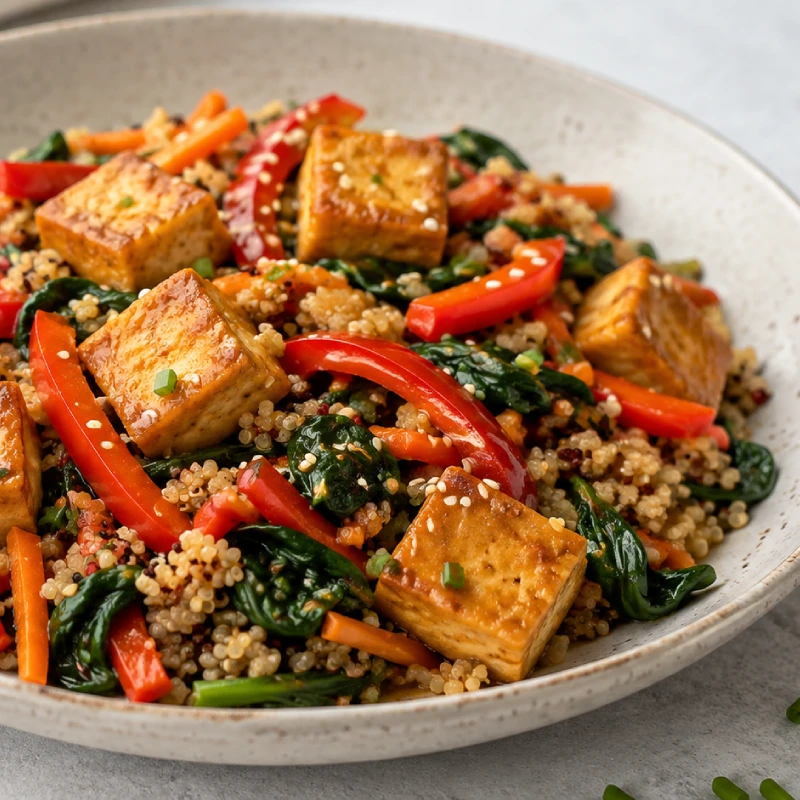
A good stir-fry should feel generous: colourful vegetables, plenty of flavour, a satisfying protein source and enough texture to make every bite interesting.
This Low FODMAP firm tofu stir-fry with quinoa, bell pepper and spinach does exactly that.
It is designed as a balanced, plant-based meal that follows the principles of the Harvard Healthy Eating Plate, with approximately half the meal coming from vegetables, one quarter from protein-rich tofu and one quarter from quinoa.
Each serving is also designed to provide at least 30 g of protein and 10 g or more of fibre, while keeping the recipe suitable for Low FODMAP eating when the specified portions are followed.
And perhaps most importantly, it does not taste like a “special diet” meal.
There is golden-edged tofu, tender quinoa, sweet red bell pepper, fresh spinach, crunchy carrots and a simple ginger-sesame sauce with garlic-infused oil.
If you are trying to eat more plant-based meals while managing IBS, bloating or digestive sensitivity, this is a lovely recipe to keep in your weekly rotation.
Table of Contents
Why You’ll Love This Low FODMAP Tofu Stir-Fry
Plant-based Low FODMAP meals sometimes require a little more planning than meals based around chicken, fish or eggs.
That is because many familiar vegetarian protein sources — particularly some legumes — can become high in FODMAPs at larger portions.
Firm tofu, however, can be extremely useful.
When paired with quinoa, vegetables and seeds, it allows us to create a meal that is satisfying, colourful and genuinely high in both protein and fibre.
This recipe gives you:
- at least 30 g of protein per serving;
- approximately 10 g or more of fibre;
- several different vegetables;
- a complete plant-based main meal;
- naturally gluten-free ingredients;
- garlic flavour without whole garlic;
- an easy meal-prep option;
- a Harvard-style plate structure.
It also uses ingredients that are widely available. There are no unusual powders or highly processed meat substitutes required.
Why Firm Tofu Works Well in Low FODMAP Cooking
There is an important distinction between firm tofu and silken tofu.
They are not interchangeable from a FODMAP perspective.
Monash University’s 2025 reintroduction update lists silken tofu within the GOS reintroduction category, highlighting that tofu type matters when considering FODMAP content.
Firm tofu is processed differently and much of the water-soluble carbohydrate is removed with the liquid during production.
That makes firm tofu a particularly useful protein choice for Low FODMAP vegetarian cooking when eaten in an appropriate portion.
For this recipe, make sure the packet specifically says firm or extra-firm tofu, rather than silken tofu.
How This Stir-Fry Follows the Harvard Healthy Eating Plate
The Harvard Healthy Eating Plate is helpful because it provides a visual way to think about balance.
Rather than counting every calorie, we can ask:
What proportion of the meal is vegetables? Where is the protein? Where is the whole-grain carbohydrate?
For this tofu stir-fry, the answer is straightforward.
Half the Plate: Vegetables
We use a generous combination of:
- red bell pepper;
- carrots;
- baby spinach.
These vegetables provide colour, fibre and a variety of nutrients without allowing the quinoa or tofu to dominate the entire bowl.
One Quarter: Healthy Plant Protein
Firm tofu provides the main protein portion.
To make sure the meal comfortably reaches our target of 30 g protein per serving, we use a generous but measured amount of firm tofu and combine it with smaller contributions from quinoa, pumpkin seeds and sesame seeds.
One Quarter: Whole-Grain Quinoa
Quinoa provides the carbohydrate portion.
Although quinoa is technically a seed, nutritionally it is commonly used like a whole grain and works beautifully in this type of plate.
It provides carbohydrate, fibre and additional protein while remaining naturally gluten-free.
Healthy Fats
Extra-virgin olive oil, sesame oil and seeds provide unsaturated fats.
The result is a meal that feels substantial without relying on a huge portion of any single ingredient.
Firm Tofu Stir-Fry with Quinoa, Bell Pepper and Spinach
Serves: 4
Prep time: 20 minutes
Cooking time: 25 minutes
Total time: approximately 45 minutes
Difficulty: Easy
Suitable for meal prep: Yes
Vegetarian: Yes
Vegan: Yes
Ingredients
For the quinoa
- 300 g dry quinoa
- 600 ml water
- Pinch of salt
For the tofu
- 800 g firm or extra-firm tofu, drained and pressed
- 2 tablespoons garlic-infused extra-virgin olive oil
- 2 tablespoons tamari or gluten-free soy sauce
- 1 teaspoon ground ginger
- Freshly ground black pepper
- 20 g cornflour, optional, for a crispier coating
For the vegetables
- 300 g red bell pepper, sliced
- 400 g carrots, cut into thin batons
- 200 g baby spinach
- 1 tablespoon garlic-infused olive oil
- 2 tablespoons chopped chives
- Green spring onion tops, optional, finely sliced
For the ginger-sesame sauce
- 3 tablespoons tamari or gluten-free soy sauce
- 2 tablespoons fresh lime juice
- 1 tablespoon toasted sesame oil
- 1 tablespoon garlic-infused olive oil
- 2 teaspoons grated fresh ginger
- 1 teaspoon maple syrup
- 2–3 tablespoons water
For extra protein and fibre
- 80 g pumpkin seeds, 20 g per serving
- 40 g sesame seeds, 10 g per serving
Optional garnish
- Fresh coriander
- Lime wedges
- Chopped chives
- Green spring onion tops
- Fresh chilli or chilli flakes, if tolerated
Low FODMAP note: Portion size matters. FODMAP content can also change as foods are retested, so check current Monash University guidance if you are in the strict restriction phase. Monash’s 2025 update includes several changes to previously tested foods and specifically distinguishes silken tofu within its reintroduction information.
How to Make Low FODMAP Tofu Stir-Fry
Step 1: Press the Tofu
Drain the tofu and remove it from its packaging.
Wrap it in clean kitchen paper or a clean tea towel and place something moderately heavy on top.
Leave it for around 10–15 minutes.
Pressing removes excess water and helps the tofu brown instead of steaming in the pan.
If you buy extra-firm tofu that is already quite dry, you may only need to pat it thoroughly with kitchen paper.
Step 2: Cook the Quinoa
While the tofu is pressing, rinse the quinoa thoroughly under cold running water.
Place it in a saucepan with the water and a pinch of salt.
Bring to the boil, then reduce the heat, cover and simmer for approximately 12–15 minutes, or until the liquid has been absorbed.
Remove from the heat and leave covered for another 5 minutes.
Fluff with a fork.
You should end up with approximately four generous cooked portions.
Step 3: Cut and Season the Tofu
Cut the pressed tofu into bite-sized cubes.
Place them in a bowl and add the garlic-infused olive oil, tamari, ground ginger and black pepper.
Toss gently.
If you would like crispier tofu, sprinkle over the cornflour and toss again until the pieces have a very thin coating.
The cornflour is optional, but it helps produce lovely golden edges.
Step 4: Cook the Tofu
Heat a large non-stick frying pan or wok over medium-high heat.
Add the tofu in a single layer.
Try not to stir it immediately.
Let the first side cook for around 3 minutes before turning.
Continue cooking for approximately 8–10 minutes in total, turning occasionally, until several sides are golden.
Transfer the tofu to a plate.
If your pan is small, cook the tofu in two batches. Overcrowding makes it much harder to achieve crisp edges.
Cook the Low FODMAP Vegetables
Step 5: Start With the Carrots
Add the garlic-infused olive oil to the same pan.
Add the carrots and stir-fry over medium-high heat for approximately 4 minutes.
The carrots should begin to soften while retaining a little bite.
If they start catching on the pan, add a tablespoon of water.
Step 6: Add the Bell Pepper
Add the sliced red bell pepper.
Cook for another 3–4 minutes.
Try not to overcook it. A little crunch gives the stir-fry much better texture.
Step 7: Add the Spinach
Add the baby spinach and chives.
Toss for approximately 1–2 minutes, just until the spinach wilts.
It will reduce in volume very quickly.
At this stage, your vegetables should still look colourful rather than soft and overcooked.
Make the Ginger-Sesame Sauce
Step 8: Mix the Sauce
In a small bowl, whisk together:
- tamari;
- lime juice;
- sesame oil;
- garlic-infused olive oil;
- grated ginger;
- maple syrup;
- water.
Taste the sauce.
If it feels too salty, add another tablespoon of water or lime juice.
If it feels too sharp, add a tiny extra drizzle of maple syrup.
The intention is to create a light coating for the stir-fry rather than a heavy, sugary sauce.
Step 9: Bring Everything Together
Return the cooked tofu to the pan with the vegetables.
Pour over the ginger-sesame sauce.
Toss gently over medium heat for approximately 1–2 minutes, until everything is coated and heated through.
Switch off the heat.
Sprinkle over the pumpkin and sesame seeds.
Build Your Harvard-Style Tofu Bowl
Divide the cooked quinoa between four bowls.
Add the tofu and vegetable stir-fry.
As a visual guide, aim for:
½ bowl: bell pepper, carrots and spinach
¼ bowl: firm tofu
¼ bowl: quinoa
Sprinkle each serving with pumpkin seeds and sesame seeds.
Finish with fresh coriander, chopped chives, green spring onion tops or a squeeze of lime.
You now have a colourful plant-based meal with substantial protein, fibre and vegetables — without needing to make the portions enormous.
How This Recipe Reaches 30 g of Protein
Getting enough protein is one of the most common concerns people have when eating more plant-based meals.
In this recipe, the protein is distributed across several ingredients.
Each serving includes approximately:
- 200 g firm tofu;
- a serving of quinoa;
- 20 g pumpkin seeds;
- 10 g sesame seeds.
Together, these are designed to provide at least 30 g protein per serving, although the exact total will depend on the tofu and quinoa brands you use.
The nutrition label on tofu is particularly useful because protein content can vary considerably between products.
Choose a Higher-Protein Firm Tofu
When shopping, compare packets.
For this recipe, a firm tofu providing approximately 12–15 g protein per 100 g makes reaching the 30 g target straightforward.
If your tofu contains considerably less protein, you can either:
- choose a higher-protein brand;
- slightly increase the tofu portion within your tolerated Low FODMAP amount;
- increase the pumpkin seeds modestly;
- adjust the quinoa portion.
The objective is not to force a perfect number from one food.
It is to let the whole meal work together.
How This Recipe Reaches 10 g of Fibre
Fibre comes from several different ingredients:
- quinoa;
- carrots;
- red bell pepper;
- spinach;
- tofu;
- pumpkin seeds;
- sesame seeds.
Together, they are designed to provide approximately 10 g or more of fibre per serving.
Again, exact values will vary.
The important part is the structure: several plant foods contribute moderate amounts rather than one ingredient having to carry the whole fibre target.
This can be particularly useful for people with sensitive digestion.
A Note About Fibre and IBS
Fibre is important, but increasing it very quickly can sometimes increase bloating or gas.
If you currently eat relatively little fibre, jumping straight to a high-fibre meal at every sitting may not feel comfortable.
Increase gradually.
Drink enough fluid.
And pay attention to your own response.
A nutrition target is useful, but your digestive comfort matters too.
A meal can be nutritionally excellent on paper and still need adapting to suit the person eating it.
Is Firm Tofu Low FODMAP?
Firm tofu can be used as a Low FODMAP protein in appropriate portions.
The important word here is firm.
Silken tofu is different.
Monash University’s 2025 update includes silken tofu as a GOS reintroduction food.
That distinction matters because tofu varieties are processed differently.
When buying tofu for this recipe, choose a product clearly labelled:
- firm tofu;
- extra-firm tofu.
Avoid substituting silken tofu if you are relying on the recipe’s Low FODMAP structure.
Silken tofu would also behave very differently in a stir-fry: it is much softer and would be difficult to brown into cubes.
Is Quinoa Low FODMAP?
Quinoa can fit very comfortably into a Low FODMAP meal when used in an appropriate serving.
It is particularly helpful here because it gives us a naturally gluten-free carbohydrate source while also contributing fibre and protein.
Unlike white rice, it also provides a little more texture and makes a plant-based meal feel substantial.
For meal prep, quinoa is excellent.
Cook a batch once and use it for several lunches or dinners.
Why Garlic-Infused Oil Instead of Garlic?
Traditional stir-fries often begin with garlic.
Unfortunately, garlic is high in fructans.
Monash University’s 2025 reintroduction update continues to identify garlic separately within the fructan – garlic category.
Using garlic-infused oil lets us keep that familiar savoury flavour without putting pieces of garlic into the stir-fry.
Do not substitute garlic powder.
Garlic powder contains garlic itself, so it is not equivalent to an infused oil from a FODMAP perspective.
The same applies to many bottled stir-fry sauces.
Always check ingredient lists because onion and garlic powders are very common.
What About Soy Sauce?
Soy sauce or tamari is used here as a seasoning rather than as a large-volume ingredient.
I prefer tamari for this recipe because it is easy to find in gluten-free versions and provides a rich savoury flavour.
Check the ingredient label, particularly if you require strict gluten avoidance as well as Low FODMAP eating.
Remember that gluten-free and Low FODMAP are separate concepts.
Someone following a Low FODMAP Diet does not automatically need to eliminate gluten unless there is another clinical reason to do so.
Can I Use Silken Tofu Instead?
Not for this recipe.
From a cooking perspective, silken tofu is too delicate for this stir-fry technique.
From a FODMAP perspective, it also needs to be considered separately.
Monash’s updated 2025 reintroduction guide continues to include silken tofu specifically within GOS reintroduction.
So if a recipe calls for firm tofu, use firm tofu.
They are not simply different textures of the same interchangeable food.
Is Bell Pepper Low FODMAP?
Bell pepper can be incorporated into Low FODMAP meals in suitable portions.
For this recipe, the pepper is divided between four servings and combined with carrots and spinach rather than being used as the only vegetable.
That helps us create variety while keeping individual portions sensible.
Colour is useful too.
Using red bell pepper alongside orange carrot and dark green spinach gives the meal several different plant foods without requiring an enormous number of ingredients.
Plant Variety Without FODMAP Overload
It is tempting, when trying to make a meal “healthier”, to keep adding more and more vegetables, seeds and legumes.
But with Low FODMAP cooking, more is not automatically better.
FODMAP load is influenced by serving size and combinations.
That is why this recipe uses several carefully portioned plant foods instead of adding large quantities of beans, lentils, avocado and nuts all at once.
Monash’s 2025 update reinforces how nuanced FODMAP composition can be. Foods including almonds, canned chickpeas and green peas were updated because testing showed combinations of GOS and fructans rather than only the previously identified FODMAP group.
This is one reason old “safe food” and “unsafe food” lists are not particularly helpful.
Low FODMAP eating is much more about food, portion and personal tolerance.
Can I Meal Prep This Tofu Stir-Fry?
Yes. This is an excellent meal-prep recipe.
Cook the quinoa, tofu and vegetables, then divide everything between four containers.
Allow the food to cool appropriately and refrigerate according to local food-safety recommendations.
For the Best Texture
If you want the tofu to remain as crisp as possible, store it separately from the vegetables and sauce.
Then reheat the tofu in a frying pan or air fryer and combine everything just before eating.
If convenience matters more than crispiness, storing everything together is completely fine.
Prepare the Ingredients Ahead
You can also do most of the prep without cooking.
The day before, you can:
- press and cube the tofu;
- slice the peppers;
- cut the carrots;
- wash the spinach;
- cook the quinoa;
- prepare the ginger-sesame sauce.
Then the actual stir-fry takes only a few minutes.
Easy Low FODMAP Variations
Once you understand the structure, this recipe is easy to adapt.
Swap the Quinoa for Brown Rice
Brown rice works beautifully if you prefer a milder flavour.
Maintain roughly the same Harvard-style proportions:
half vegetables, one quarter tofu and one quarter brown rice.
Make It More Lemony
Replace the lime juice with lemon juice.
The flavour will be slightly softer but still very fresh.
Add More Fresh Herbs
Try:
- coriander;
- chives;
- Thai basil;
- mint.
Fresh herbs are one of the easiest ways to make Low FODMAP meals taste vibrant.
Add Chilli
If you personally tolerate spicy foods, add fresh chilli or chilli flakes.
Remember that chilli can be Low FODMAP but still aggravate symptoms in some people with IBS.
FODMAP status is not the same thing as individual tolerance.
Use Different Vegetables
You can vary the vegetables according to current Low FODMAP serving guidance and your personal tolerance.
Do not assume that an older food list is still completely current.
The Monash 2025 update changed the reported FODMAP profile or rating of several vegetables, including beetroot, Brussels sprouts, Savoy cabbage, cauliflower, celery, green peas and sugar snap peas.
Low FODMAP Does Not Have to Mean Low in Plants
This is particularly important for vegetarian and vegan readers.
Following a Low FODMAP Diet does not mean you need to live on rice and a handful of vegetables.
You can still build meals around:
- suitable tofu;
- quinoa;
- vegetables;
- seeds;
- appropriate nuts;
- grains;
- tolerated legumes during later stages of personalisation.
The goal is to choose portions thoughtfully.
And over the longer term, the goal is to bring back as much variety as your individual tolerance allows.
Remember the Reintroduction Phase
The Low FODMAP Diet is not intended to become an indefinitely restrictive eating pattern.
After the initial restriction period, reintroduction helps you discover which FODMAP groups you tolerate and in what quantities.
Monash University’s 2025 update includes reintroduction foods across categories including:
- lactose;
- sorbitol;
- mannitol;
- fructose;
- GOS;
- fructan from grain foods;
- fructan from vegetables and fruit;
- fructan from garlic;
- fructan from onion;
- fructose plus sorbitol;
- fructan plus GOS.
The update specifically lists silken tofu as a GOS reintroduction food.
This is a good example of why personalisation matters.
The ultimate goal is not to avoid as many plant foods as possible.
It is to understand your digestive tolerance well enough to eat the broadest, most varied diet that works for you.
A Balanced Plant-Based Low FODMAP Dinner
Plant-based Low FODMAP cooking can require a little extra thought, particularly when you want a meal that is genuinely high in protein rather than simply “containing some tofu”.
But once we build the plate deliberately, it becomes much easier.
This bowl gives you:
firm tofu for protein, quinoa for whole-grain-style carbohydrate, colourful vegetables for volume and fibre, seeds for extra protein and healthy fats, and a simple ginger-sesame dressing for flavour.
Each serving is designed to provide 30+ g of protein and approximately 10+ g of fibre, while the visual proportions follow the principles of the Harvard Healthy Eating Plate.
And that is what a useful Low FODMAP recipe should do.
It should not simply remove ingredients.
It should help you create a meal that is satisfying, nourishing and enjoyable enough that you genuinely want to make it again.
CTA: Save this Low FODMAP tofu stir-fry for your next plant-based dinner and make a double batch of quinoa so you have an easy base ready for another meal later in the week.
Suggested internal links:
- High-Protein Vegetarian Low FODMAP Meals
- Best Low FODMAP Sources of Plant Protein
- How to Get Enough Fibre on a Low FODMAP Diet
- Low FODMAP Meal Prep for Beginners
- Low FODMAP Garlic and Onion Alternatives
- Low FODMAP Reintroduction Guide
- Easy Low FODMAP Dinner Recipes
Recommended schema: Recipe + Article + FAQPage. If this article appears on the website of an eligible dietitian, nutrition practice or clinic with a physical location, LocalBusiness schema may also be appropriate at site level.
Frequently Asked Questions
Is firm tofu Low FODMAP?
Firm or extra-firm tofu can be incorporated into Low FODMAP eating in appropriate portions. It is important not to confuse it with silken tofu, which is treated differently. Monash University’s 2025 update lists silken tofu specifically within its GOS reintroduction category.
Is silken tofu the same as firm tofu?
No. They have different textures, manufacturing processes and FODMAP considerations. For this stir-fry, choose firm or extra-firm tofu. Silken tofu is too delicate for browning and appears separately in Monash’s updated GOS reintroduction guidance.
Does this tofu stir-fry provide 30 g of protein?
Yes. The recipe has been designed to provide at least 30 g of protein per serving through a combination of approximately 200 g firm tofu, quinoa, pumpkin seeds and sesame seeds. Exact amounts will vary according to the tofu brand you purchase.
How does this recipe reach 10 g of fibre?
Quinoa, carrots, bell pepper, spinach, tofu, pumpkin seeds and sesame seeds all contribute fibre. Together, the specified portions are designed to provide approximately 10 g or more per serving.
Can I use rice instead of quinoa?
Absolutely. Brown rice is the best swap if you want to maintain the whole-grain emphasis of the Harvard plate. Keep approximately one quarter of your bowl rice, one quarter tofu and half vegetables.
Why do I need to press tofu?
Removing excess water helps firm tofu brown more successfully. If the tofu contains too much water, it tends to steam in the pan instead of developing crisp golden edges.
Can I use garlic in the stir-fry?
During the Low FODMAP restriction phase, whole garlic is generally avoided because of its fructans. Monash’s 2025 reintroduction update continues to identify garlic specifically as the challenge food for the fructan-garlic category. This recipe uses garlic-infused oil instead.
Can I use garlic powder?
Garlic powder is not the same as garlic-infused oil. It contains the garlic itself and therefore is not an appropriate direct substitute during strict Low FODMAP restriction.
Is this recipe vegan?
Yes. All of the ingredients are plant-based, provided you choose sauces and condiments that do not contain animal-derived additions.
Is this recipe gluten-free?
The core ingredients are naturally gluten-free, but use a certified gluten-free tamari rather than ordinary soy sauce if strict gluten avoidance is necessary. Always check individual product labels.
Can I make this recipe without pumpkin seeds?
Yes, although they help increase both the protein and fibre content. If you remove them, the complete meal may need adjusting to maintain the target of at least 30 g protein and 10 g fibre per serving.
Is this stir-fry suitable for meal prep?
Yes. Quinoa, tofu and cooked vegetables can all be prepared ahead. For the crispiest tofu, store it separately from the sauce and vegetables and reheat it in a pan or air fryer before serving.
Can I eat this during the Low FODMAP elimination phase?
The recipe has been designed using Low FODMAP ingredients and measured portions, but individual foods and serving sizes should still be checked against current Monash guidance if you are following the elimination phase strictly. FODMAP classifications can be updated as foods are retested, as Monash’s 2025 update demonstrates.
Do I need to stay Low FODMAP permanently?
The restrictive stage is not intended to become unnecessarily permanent. Reintroduction and personalisation help identify the types and quantities of FODMAPs you personally tolerate. The long-term aim is usually to achieve the most varied diet possible while keeping symptoms manageable.
A plant-based Low FODMAP plate does not need to be complicated. Start with a protein you tolerate, add plenty of colourful vegetables, include a satisfying whole-grain carbohydrate and build flavour with herbs, ginger, citrus and infused oils. Simple can still be beautifully nourishing.