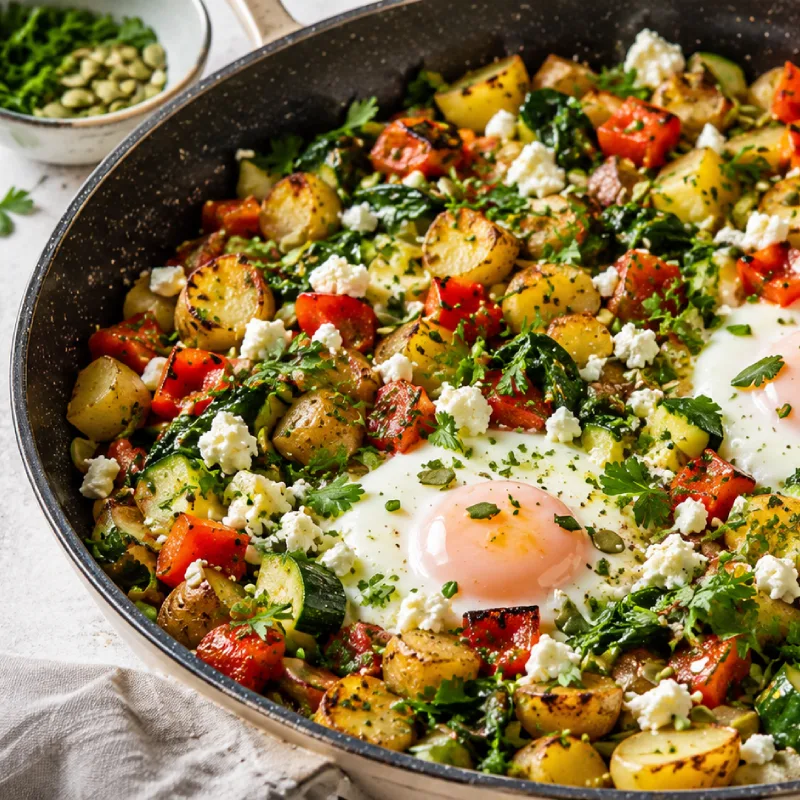
There are days when the best meal is the one you can make in a single pan.
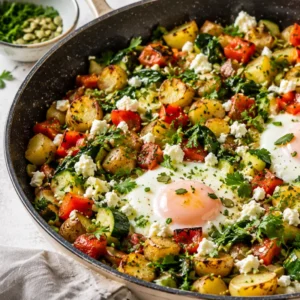
Warm golden potatoes. Soft eggs. Wilted spinach. Creamy feta. A handful of herbs on top.
Simple food, but deeply satisfying.
This Low FODMAP egg and potato skillet with spinach and feta has been designed to turn that familiar combination into a genuinely balanced meal. Each serving provides at least 30 g of protein and approximately 10 g or more of fibre, while keeping the ingredients suitable for a Low FODMAP eating pattern when the specified portions are followed.
We are also using the principles of the Harvard Healthy Eating Plate to make sure the skillet is not simply a very large portion of potatoes topped with eggs.
Potatoes are delicious and absolutely have a place here, but they are not counted as the vegetable half of the Harvard plate. So we build the skillet with plenty of spinach, courgette and red bell pepper alongside a moderate portion of potato, then use eggs, egg whites, feta and pumpkin seeds to provide protein.
The result is colourful, comforting and surprisingly versatile.
You can make it for breakfast, brunch, lunch or dinner.
And if you are following a Low FODMAP Diet because of IBS, bloating or digestive sensitivity, it is a particularly useful recipe because it proves that a balanced meal does not need a complicated ingredient list.
Table of Contents
Why You’ll Love This Low FODMAP Egg and Potato Skillet
One-pan meals are wonderful when your energy is low or your week is busy.
But they can easily become nutritionally unbalanced. A potato skillet, for example, may contain a large quantity of potatoes, a couple of eggs and just a handful of spinach.
Tasty? Absolutely.
But if we want the meal to provide at least 30 g protein, plenty of fibre and a generous vegetable portion, we need to be a little more intentional.
This version gives you:
- 30+ g of protein per serving;
- approximately 10+ g of fibre per serving;
- plenty of colourful vegetables;
- a measured portion of potatoes;
- healthy fats from extra-virgin olive oil and pumpkin seeds;
- flavour without onion or whole garlic;
- a naturally gluten-free meal;
- an easy vegetarian Low FODMAP dinner;
- one-pan cooking with minimal washing up.
It is also very beginner-friendly.
There is no complicated sauce, no specialist cooking technique and no need to prepare five separate components.
Why Use Both Whole Eggs and Egg Whites?
Whole eggs are wonderfully nutritious and give the skillet its richness.
But if we relied only on whole eggs to reach more than 30 g of protein per person, we would need a rather large number.
Instead, this recipe combines two whole eggs per serving with approximately 100 g of egg whites.
That gives us plenty of protein while keeping the meal balanced and allowing room for feta, vegetables, potatoes and seeds.
The whole eggs provide flavour and texture.
The egg whites quietly increase the protein.
It is a simple trick that works very well in breakfast-style meals.
Where Does the Fibre Come From?
Eggs and feta do not provide fibre, so we need to build it through the plant foods in the skillet.
Here, fibre comes from:
- skin-on potatoes;
- spinach;
- courgette;
- red bell pepper;
- pumpkin seeds.
Rather than trying to get 10 g of fibre from one enormous serving of vegetables, the total is spread across several foods.
For someone with a sensitive digestive system, that can be a much more practical way to build a higher-fibre meal.
How This Recipe Follows the Harvard Healthy Eating Plate
The Harvard Healthy Eating Plate encourages us to build meals around three broad proportions:
- roughly half the meal from vegetables and fruit;
- approximately one quarter from healthy protein;
- approximately one quarter from whole grains;
- alongside healthy plant oils.
This particular recipe needs a small adaptation because the carbohydrate is potato rather than a whole grain.
Potatoes Are Not the Vegetable Half
This distinction matters.
It is tempting to look at a skillet containing potatoes and spinach and say, “Most of this is vegetables.”
But under the Harvard Healthy Eating Plate model, potatoes are not counted in the vegetable section.
So for this recipe, the potatoes behave more like the starchy carbohydrate component of the meal.
That means we deliberately add plenty of spinach, courgette and red bell pepper.
Visually, we want the non-starchy vegetables to occupy close to half the meal.
The Protein Quarter
The protein comes mainly from:
- whole eggs;
- egg whites;
- feta;
- pumpkin seeds.
Together, they allow each serving to reach well over 30 g of protein without making the skillet feel like a giant omelette.
What If You Want to Follow the Harvard Plate More Literally?
Because Harvard specifically prioritises whole grains, you could replace part of the potato portion with a small serving of quinoa or brown rice.
However, I would not force a whole grain into a dish simply for the sake of making the diagram perfect.
The more useful principle here is balance:
plenty of vegetables + a sensible starchy carbohydrate portion + enough protein + healthy fats.
That is exactly what this skillet provides.
Egg and Potato Skillet with Spinach and Feta
Serves: 4
Prep time: 15 minutes
Cooking time: 30 minutes
Total time: approximately 45 minutes
Difficulty: Easy
Vegetarian: Yes
Gluten-free: Naturally, when individual packaged ingredients are checked
Meal prep friendly: Partially — the vegetables and potatoes can be prepared ahead
Ingredients
For the potato and vegetable skillet
- 800 g baby potatoes, approximately 200 g per serving
- 260 g courgette (zucchini), diced
- 300 g red bell pepper, diced or sliced
- 300 g baby spinach
- 2 tablespoons garlic-infused extra-virgin olive oil
- 1 teaspoon smoked paprika
- 1 teaspoon dried oregano
- ½ teaspoon salt
- Freshly ground black pepper
For the eggs
- 8 large eggs
- 400 g liquid egg whites, approximately 100 g per serving
- Pinch of salt
- Freshly ground black pepper
To finish
- 160 g feta, approximately 40 g per serving
- 80 g pumpkin seeds, approximately 20 g per serving
- 2 tablespoons chopped fresh chives
- 2 tablespoons chopped fresh parsley
- Lemon wedges, optional
- Green tops of spring onions, finely sliced, optional
Low FODMAP note: FODMAP content depends on serving size, and food-testing information can change over time. Monash University’s 2025 update shows that several vegetables and other foods have been retested and reclassified, so current serving information is important during the strict restriction phase.
Use the current Monash FODMAP app to confirm individual portions when needed.
How to Make This Low FODMAP Egg and Potato Skillet
Step 1: Prepare the Potatoes
Wash the potatoes thoroughly.
Keep the skins on if you enjoy them, as this helps retain a little more fibre.
Cut the potatoes into small cubes of approximately 1.5–2 cm.
Keeping the pieces relatively small is important. Large potato chunks take much longer to soften and can leave you with burnt vegetables and undercooked potatoes.
Step 2: Part-Cook the Potatoes
Place the potato cubes in a saucepan and cover with water.
Bring to the boil and simmer for approximately 6–8 minutes, until they are beginning to soften but are not completely cooked.
Drain thoroughly.
This extra step makes the skillet much easier.
You could cook raw potatoes entirely in the frying pan, but it requires more oil and considerably more time. Parboiling gives you a fluffy centre and allows the outside to become golden later.
Step 3: Brown the Potatoes
Heat a large non-stick or well-seasoned frying pan over medium-high heat.
Add one tablespoon of garlic-infused olive oil.
Add the drained potatoes.
Sprinkle with smoked paprika, oregano, salt and black pepper.
Cook for approximately 7–8 minutes, turning occasionally, until the potatoes develop golden edges.
Do not stir continuously.
Giving the potatoes a little uninterrupted contact with the hot pan helps them brown.
Step 4: Add the Courgette and Bell Pepper
Add the remaining tablespoon of garlic-infused oil.
Add the diced courgette and red bell pepper.
Cook for approximately 5–6 minutes, stirring occasionally.
You want the vegetables tender but not completely soft.
A little texture makes the final skillet much more satisfying.
Step 5: Add the Spinach
Add the baby spinach in two or three batches.
At first it may look like an enormous amount, but spinach reduces dramatically once heated.
Gently toss it through the potatoes and vegetables.
Cook for approximately 1–2 minutes, just until wilted.
You should now have a colourful base with plenty of green, red and golden vegetables.
Add the Eggs
Step 6: Make Space for the Eggs
Reduce the heat to medium-low.
Use a wooden spoon to create eight small spaces in the vegetable and potato mixture.
These do not need to be deep holes — simply areas where the whole eggs can sit.
Step 7: Add the Egg Whites First
Pour the egg whites evenly around the skillet, allowing them to settle between the potatoes and vegetables.
Cook gently for approximately 2 minutes.
They will begin to turn opaque.
Adding the whites first gives them a little extra time to set without overcooking the whole egg yolks.
Step 8: Crack in the Whole Eggs
Crack one egg into each space.
Season lightly with salt and black pepper.
Cover the pan with a lid.
Cook over low-to-medium heat for approximately 5–7 minutes, depending on how you like your eggs.
For softer yolks, remove the pan when the whites are completely set but the yolks still have some movement.
If you prefer firmer eggs, cook them a little longer.
If food safety is particularly important for you, follow the current egg-cooking guidance relevant to your country and circumstances.
Step 9: Add the Feta
Once the eggs are almost ready, crumble the feta over the skillet.
Cover again for approximately 1 minute.
The feta does not need to melt completely. It is lovely when it remains in soft, creamy pieces.
Step 10: Finish With Seeds and Herbs
Remove the skillet from the heat.
Sprinkle over the pumpkin seeds, fresh chives and parsley.
Add the green spring onion tops if using.
Finish with freshly ground black pepper and a squeeze of lemon if you enjoy a little acidity.
Divide into four servings, making sure each person receives:
- two whole eggs;
- approximately one quarter of the egg whites;
- roughly 200 g potato;
- a generous quantity of vegetables;
- 40 g feta;
- 20 g pumpkin seeds.
And that is your meal.
How This Skillet Reaches 30 g of Protein
This recipe is intentionally higher in protein than a traditional two-egg breakfast.
Each serving includes approximately:
- 2 whole eggs;
- 100 g egg whites;
- 40 g feta;
- 20 g pumpkin seeds;
- smaller amounts of protein from potatoes, spinach and the other vegetables.
Together, this combination is designed to provide approximately 30–35+ g of protein per serving.
The exact amount depends on the size of your eggs and the brands of egg whites, feta and pumpkin seeds you use.
Why Not Just Add More Eggs?
You could.
But there is a point where adding more whole eggs changes the balance and texture of the dish.
Using egg whites allows us to increase the protein without turning the skillet into an oversized omelette.
It also leaves plenty of room on the plate for vegetables.
That matters if we are trying to follow the Harvard plate principles rather than simply hitting a protein target.
How This Recipe Reaches 10 g of Fibre
The fibre comes mainly from:
- approximately 200 g potatoes with skin;
- courgette;
- bell pepper;
- spinach;
- pumpkin seeds.
Together, the specified portions are designed to provide around 10 g or more of fibre per serving.
This may vary slightly depending on your vegetables and exact portion sizes.
The key is not to reduce the vegetables to a handful of spinach.
The generous vegetable portion is what makes the recipe work nutritionally.
Keep the Potato Skin When You Can
If the potatoes are suitable for eating with their skins, simply wash them thoroughly rather than peeling them.
The skin contributes additional fibre and gives the finished skillet a lovely texture.
There is no need to peel baby potatoes unless you prefer them that way.
Is This Egg and Potato Skillet Low FODMAP?
The recipe is designed using foods that can fit into Low FODMAP eating at appropriate serving sizes.
However, Low FODMAP is not simply a question of whether an ingredient appears on a “yes” or “no” list.
Quantity matters.
The same food may be Low FODMAP at one serving and higher in FODMAPs at a larger serving.
That is why the vegetables in this recipe are deliberately distributed between four portions.
Monash University’s 2025 update is a useful reminder that FODMAP testing also evolves. Several foods received updated FODMAP ratings or classifications after being retested.
If you are in the elimination phase, current app information is more useful than an old printable list from the internet.
Are Eggs Low FODMAP?
Plain eggs do not contain the fermentable carbohydrates classified as FODMAPs.
That makes them a particularly useful protein source during Low FODMAP eating.
The ingredients cooked with eggs are often more relevant.
For example, a café omelette or breakfast skillet may contain:
- onion;
- garlic;
- regular sausage;
- seasoning blends;
- sauces;
- large portions of higher-FODMAP vegetables.
Making your skillet at home means you know exactly what has gone into it.
Is Feta Low FODMAP?
Feta is a relatively firm cheese and can generally be included in appropriate portions in a Low FODMAP meal.
For this recipe, we use approximately 40 g per person.
That is enough to add creaminess and a salty flavour without needing a heavy cheese sauce.
If lactose is particularly important for you, check your individual product and current serving guidance.
Monash’s 2025 reintroduction update reinforces that dairy foods can differ considerably in lactose content. For example, the updated material changed the recommended lactose reintroduction foods and notes that ricotta did not contain enough lactose in easily consumed serving sizes to serve as the preferred challenge food.
The broader lesson is useful: do not assume every cheese or dairy food behaves identically.
Why Use Garlic-Infused Olive Oil?
Garlic is a common ingredient in potato skillets.
It is also high in fructans.
Monash University’s 2025 reintroduction guidance continues to list garlic as its own fructan challenge, separate from onion.
For the restriction phase, garlic-infused oil gives us a practical way to recreate some of that flavour without adding whole garlic to the pan.
Do not replace it with garlic powder.
Garlic powder contains the garlic itself and is not equivalent to an infused oil from a FODMAP perspective.
What About Onion?
We skip ordinary onion too.
Instead, the recipe uses:
- chives;
- optional green spring onion tops;
- herbs;
- smoked paprika.
They give the skillet plenty of savoury flavour without requiring onion.
Monash’s 2025 update continues to list onion as a separate fructan reintroduction challenge from garlic.
That distinction is particularly useful once you reach personalisation because someone may tolerate one differently from the other.
Fibre, IBS and a Sensitive Gut
A meal containing 10 g or more of fibre can be very useful nutritionally, but it is important to consider where you are starting.
If you currently eat relatively little fibre, jumping immediately to a much higher intake can increase:
- gas;
- bloating;
- fullness;
- changes in bowel habits.
That does not necessarily mean the meal is unsuitable.
Your gut may simply need a more gradual increase.
You can initially use a smaller serving of pumpkin seeds or vegetables and build towards the full recipe.
Drink enough water as well.
Especially when managing IBS, the best nutrition plan is not the one with the most impressive numbers on paper.
It is the one that gives you adequate nutrition and feels manageable for your body.
Can You Make This Skillet Ahead?
Yes — partially.
Eggs are nicest when freshly cooked, so I would prepare the potato and vegetable base in advance and add the eggs shortly before serving.
Meal-Prep Option
Cook the potatoes, courgette and bell pepper.
Allow everything to cool properly.
Store in an airtight container in the refrigerator according to local food-safety recommendations.
When you are ready to eat:
- Reheat the vegetable and potato mixture thoroughly in the skillet.
- Add fresh spinach.
- Pour in the egg whites.
- Crack in the whole eggs.
- Add the feta.
- Finish with pumpkin seeds and herbs.
You get the convenience of meal prep without reheated eggs.
Make Individual Portions
If you live alone or cook for two people, simply halve the recipe.
You can also prepare the full vegetable mixture and cook only the number of eggs you need that day.
Easy Low FODMAP Variations
The basic structure of this recipe is very flexible.
Keep the formula:
vegetables + moderate potato portion + eggs + flavour + protein boost.
Add Fresh Dill
Dill works beautifully with eggs and feta.
Add a generous handful just before serving.
Add a Little Chilli
If chilli agrees with you personally, sprinkle some chilli flakes over the finished skillet.
Remember that a food can be Low FODMAP and still trigger symptoms for an individual.
Spice sensitivity and FODMAP sensitivity are not the same thing.
Change the Cheese
If you tolerate another suitable cheese and prefer its flavour, you can substitute it for feta.
Just remember that the protein and lactose content may change.
Use Different Vegetables
You can vary the vegetables according to current Low FODMAP serving guidance.
This is an area where staying up to date is particularly useful.
Monash University’s 2025 re-testing resulted in changes for vegetables including beetroot, Brussels sprouts, Savoy cabbage, cauliflower, celery, frozen green peas and sugar snap peas.
So if you want to make substantial substitutions, check current serving information rather than assuming an old classification still applies.
A Better Way to Think About Low FODMAP Meals
It is very easy for the Low FODMAP Diet to become focused entirely on subtraction.
No garlic.
No onion.
Avoid this.
Check that.
Reduce that portion.
And while those details matter during the appropriate stage of the diet, your meal still needs to provide nutrition.
When building a Low FODMAP plate, ask yourself four questions:
- Where is my protein?
- Where are my vegetables?
- Where is my fibre?
- Where is my satisfying carbohydrate?
This skillet answers all four.
Eggs, egg whites, feta and pumpkin seeds provide protein.
Spinach, courgette and red bell pepper provide vegetables.
Potatoes, vegetables and seeds provide fibre.
Potatoes provide the main carbohydrate.
And garlic-infused olive oil, herbs and feta make it taste like a meal you actually want to eat.
Remember That Low FODMAP Is Not Meant to Stay Highly Restrictive Forever
The Low FODMAP Diet includes a reintroduction and personalisation stage.
The aim is to learn which FODMAP groups and quantities you personally tolerate.
Monash University’s 2025 reintroduction update includes challenge foods across lactose, sorbitol, mannitol, fructose, GOS and multiple fructan categories. Garlic and onion remain separate fructan challenges in the updated material.
This matters because the long-term goal is not to avoid every possible FODMAP.
It is to build as much variety back into your diet as your individual digestion allows.
If your diet is becoming progressively more restricted, or you are unsure how to begin reintroduction, support from a FODMAP-trained dietitian can be very helpful.
A Simple Skillet Worth Making Again
This Low FODMAP egg and potato skillet with spinach and feta is exactly the kind of recipe that can make everyday eating easier.
There are no complicated sauces.
No unusual ingredients.
No separate side dishes to prepare.
Everything comes together in one pan.
Yet each serving is designed to provide 30+ g of protein, approximately 10+ g of fibre, plenty of vegetables and a satisfying portion of potatoes.
The spinach, courgette and bell pepper help us move towards the vegetable-heavy proportions encouraged by the Harvard Healthy Eating Plate, while the eggs and egg whites provide substantial protein and the feta gives the whole dish that creamy, salty finish that makes it feel comforting.
Because nutritious food should not feel like an assignment.
Sometimes it can simply be potatoes, eggs and feta bubbling away in a pan — just put together with a little more thought.
CTA: Save this Low FODMAP egg and potato skillet for your next quick dinner or weekend brunch. Prep the potato and vegetable mixture ahead and add the eggs fresh when you are ready to eat.
Suggested internal links:
- High-Protein Low FODMAP Breakfast Ideas
- How to Get 30 g of Protein at Breakfast
- How to Increase Fibre on a Low FODMAP Diet
- Easy Vegetarian Low FODMAP Recipes
- Low FODMAP Meal Prep for Beginners
- Low FODMAP Garlic and Onion Alternatives
- How to Start FODMAP Reintroduction
Recommended schema: Recipe + Article + FAQPage. If the recipe is published on the website of an eligible dietitian, nutrition clinic or healthcare practice with a physical location, LocalBusiness schema can also be added at site level.
Frequently Asked Questions
Are eggs Low FODMAP?
Yes. Plain eggs do not contain FODMAP carbohydrates, so they are a very useful protein source for Low FODMAP meals. Pay more attention to what is cooked with the eggs, such as onion, garlic, sauces or processed meats.
Does this recipe contain at least 30 g of protein?
Yes. Each serving contains two whole eggs, approximately 100 g of egg whites, 40 g feta and 20 g pumpkin seeds. Together with the smaller contributions from potatoes and vegetables, the meal is designed to provide approximately 30–35 g or more of protein.
How does the skillet reach 10 g of fibre?
The fibre comes from skin-on potatoes, spinach, courgette, red bell pepper and pumpkin seeds. Keeping the full vegetable portions is important if you want the complete serving to reach approximately 10 g or more.
Can I make it without egg whites?
Yes, but the protein content will be lower. You could increase the number of whole eggs, although this will change the nutritional balance and texture. Using both whole eggs and egg whites is an easy way to achieve the 30 g protein target.
Can I peel the potatoes?
Of course. The recipe will still work, but keeping the skin on contributes extra fibre. Wash the potatoes thoroughly if you are leaving the skin intact.
Are potatoes Low FODMAP?
Plain potatoes can be incorporated into Low FODMAP meals. They provide the main starchy carbohydrate in this recipe. Remember that Harvard’s Healthy Eating Plate does not count potatoes towards the vegetable half, which is why this skillet also includes a generous amount of spinach, courgette and bell pepper.
Is feta Low FODMAP?
Feta can generally fit into Low FODMAP eating in an appropriate portion. This recipe uses approximately 40 g per serving. If lactose is a particular concern for you, check your product and the most current serving guidance.
Why does the recipe use garlic-infused oil?
Whole garlic is high in fructans. Monash University’s 2025 reintroduction material continues to identify garlic as a specific fructan challenge. Garlic-infused oil gives the skillet garlic flavour without using garlic pieces.
Can I add ordinary onion?
During strict Low FODMAP restriction, ordinary onion is generally avoided because of its fructans. Onion remains a separate fructan reintroduction category in Monash’s 2025 guidance. Chives and suitable green spring onion tops are easy alternatives.
Is this recipe vegetarian?
Yes. It contains eggs and dairy but no meat or fish.
Is it gluten-free?
The core ingredients are naturally gluten-free. If you need strict gluten avoidance for a medical reason, check the labels of feta, egg whites, spices and any other packaged ingredients for cross-contamination or additives.
Can I eat this for dinner instead of breakfast?
Absolutely. The nutritional needs of your body do not change because eggs are traditionally associated with breakfast. With vegetables, potatoes, protein and healthy fats, this is a complete lunch or dinner too.
Can I meal prep this recipe?
The potato and vegetable base is excellent for meal prep. For the best texture, prepare that portion ahead and cook the egg whites and whole eggs fresh when you are ready to eat.
Can I use frozen spinach?
Yes. Thaw it first and squeeze out excess water before adding it to the skillet. Otherwise, the extra liquid can make the potatoes soggy.
Can I leave out the pumpkin seeds?
Yes, but they contribute both protein and fibre. Without them, the finished meal may fall below the intended targets, so you would need to compensate with another appropriate protein and fibre source.
Is this suitable during the Low FODMAP elimination phase?
It has been designed around Low FODMAP ingredients and measured servings, but exact tolerance and FODMAP content depend on portions and current testing. Monash University’s 2025 update demonstrates that food classifications can change when foods are retested. Check the latest app information when you are following the elimination phase closely.
Do I need to avoid FODMAPs permanently?
No. The restrictive phase is intended to be followed by reintroduction and personalisation, allowing you to identify the FODMAP groups and portions you tolerate. The aim is to create the broadest, most varied diet that works comfortably for you rather than staying unnecessarily restricted long term.
A Low FODMAP meal can be comforting, colourful and nutritionally substantial at the same time. This skillet is a lovely example: familiar ingredients, one pan and enough protein, fibre and vegetables to make it a meal rather than simply eggs on potatoes.