When you are following a Low FODMAP Diet, a simple chicken and rice bowl can become one of those wonderfully reliable meals you return to again and again. It is familiar, easy to prepare and, with a few thoughtful additions, can provide much more than chicken and white rice.
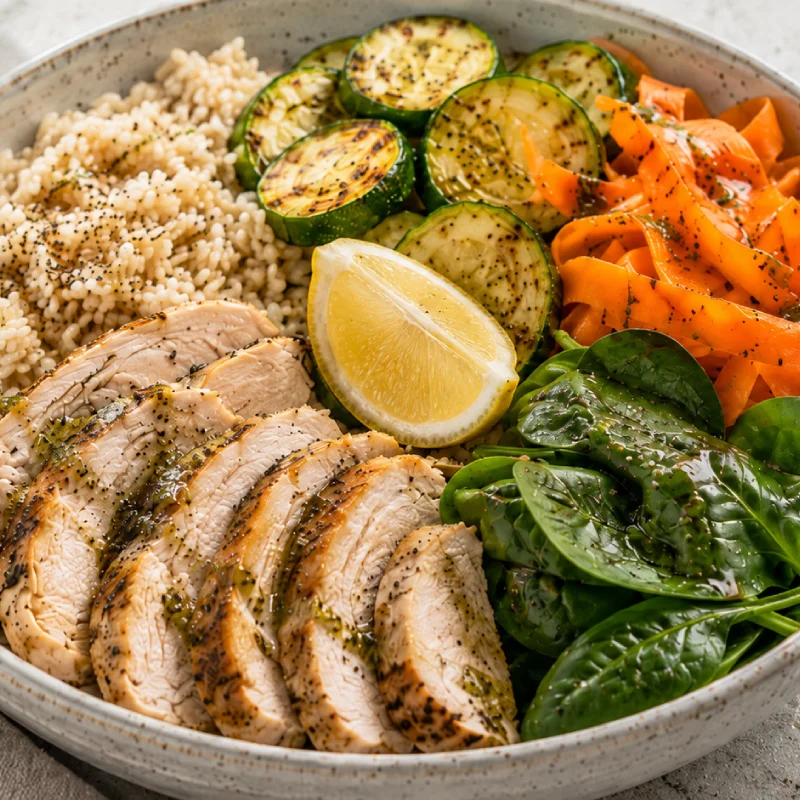
This Low FODMAP chicken rice bowl combines tender garlic-infused chicken, brown rice, colourful zucchini (courgette) and carrots, baby spinach, and a simple lemon and chia dressing. The result is a balanced bowl designed to provide at least 30 g of protein and approximately 10 g or more of fibre per serving, while keeping the ingredients suitable for a Low FODMAP meal.
It is also designed around the principles of the Harvard Healthy Eating Plate: roughly half the meal comes from vegetables, one quarter from a whole grain and one quarter from a healthy protein source. Harvard recommends prioritising vegetables and fruit, whole grains such as brown rice, healthy protein sources such as poultry, and unsaturated plant oils.
And yes, you can still have that lovely garlic flavour.
The secret is garlic-infused olive oil rather than chopped garlic. Monash University explains that garlic and onion are high in fructans, while FODMAPs are not soluble in oil. This means garlic-infused oil can provide garlic flavour without adding the garlic itself to the meal.
So if your weeknights are busy and your digestion appreciates simple, predictable meals, save this one. It is particularly good for meal prep.
Table of Contents
Why You’ll Love This Low FODMAP Chicken Rice Bowl
There is a tendency for Low FODMAP meals to become a little too focused on what needs to be removed. But a satisfying meal should also ask a different question: what can we add to make it nourishing, colourful and enjoyable?
This bowl does exactly that.
You get:
- lean chicken for plenty of protein;
- brown rice for a whole-grain carbohydrate;
- several colourful vegetables;
- extra fibre from vegetables, brown rice and chia seeds;
- healthy fats from extra-virgin olive oil;
- garlic flavour without whole garlic;
- a recipe that works beautifully for batch cooking.
It is also beginner-friendly. There are no complicated cooking techniques, unusual sauces or long lists of ingredients.
A High-Protein Low FODMAP Lunch or Dinner
Each serving is designed to comfortably exceed 30 g of protein, primarily thanks to the chicken.
Protein helps make a meal satisfying and is important for maintaining muscle and many other functions throughout the body. Harvard’s Healthy Eating Plate includes poultry among its healthy protein options.
Rather than making chicken dominate the bowl, however, we are pairing an appropriate portion with a generous quantity of vegetables.
That balance matters.
More Fibre Without Turning the Bowl Into a FODMAP Challenge
Getting enough fibre can sometimes feel complicated during the restriction phase of the Low FODMAP Diet.
People may inadvertently reduce fibre when they remove familiar breads, cereals, legumes or certain fruits and vegetables. The answer is not necessarily to suddenly add enormous quantities of one high-fibre food. A gentler strategy is to obtain fibre from several compatible foods within the same meal.
Here, fibre comes from brown rice, carrots, courgette, spinach and chia seeds.
The chia seeds are particularly useful because a relatively small portion contributes meaningful fibre without requiring an enormous volume of food. They disappear easily into the lemon dressing, too.
If you are not accustomed to eating much fibre, however, increase it gradually and make sure you are drinking enough fluid. More is not always better when it comes to a sensitive gut.
How This Bowl Follows the Harvard Healthy Eating Plate
The Harvard Healthy Eating Plate recommends making approximately half of the meal vegetables and fruits, one quarter whole grains and one quarter healthy protein. It also encourages the use of healthy plant oils and water as the main drink.
A bowl recipe can follow exactly the same principle; you do not literally need to eat the components from separate sections of a plate. Harvard specifically notes that the proportions can be applied to meals served in bowls and other formats.
For this Low FODMAP chicken rice bowl, think of your bowl like this:
½ bowl: vegetables
Courgette, carrot and baby spinach provide colour, texture and fibre.
¼ bowl: whole grains
Brown rice provides the whole-grain component. Harvard recommends choosing whole grains such as brown rice more often than refined grains such as white rice.
¼ bowl: healthy protein
Chicken breast provides a lean source of poultry protein.
Plus a little healthy fat
Garlic-infused extra-virgin olive oil adds flavour and fat without requiring garlic cloves in the finished recipe.
It is a simple formula that you can use for many other Low FODMAP meals.
Recipe: Garlic-Infused Chicken Rice Bowl with Zucchini and Carrots
Serves: 4
Prep time: 15 minutes
Cooking time: 30 minutes
Total time: approximately 45 minutes
Difficulty: Easy
Meal prep: Yes
Ingredients
For the chicken
- 600 g skinless chicken breast, cut into bite-sized pieces
- 2 tablespoons garlic-infused extra-virgin olive oil
- 1 teaspoon smoked paprika
- 1 teaspoon dried oregano
- ½ teaspoon ground cumin
- ½ teaspoon salt
- Freshly ground black pepper, to taste
For the rice and vegetables
- 600 g cooked brown rice, approximately 150 g per serving
- 400 g carrots, peeled and sliced into thin half-moons
- 400 g courgette (zucchini), sliced into half-moons
- 200 g baby spinach
- 1 tablespoon extra-virgin olive oil
- Salt and black pepper, to taste
For the lemon-chia dressing
- 80 g chia seeds, 20 g per serving
- 3 tablespoons fresh lemon juice
- 2 tablespoons garlic-infused extra-virgin olive oil
- 4 tablespoons water, plus extra as required
- 1 teaspoon Dijon mustard, choosing a product without added onion or garlic
- Pinch of salt
- Freshly ground black pepper
Optional Low FODMAP garnish
- Chopped fresh parsley
- Chives
- Lemon wedges
- Green tops of spring onions
Important: FODMAP content is portion-dependent, so serving sizes matter. Product formulations can also vary. If you are currently completing the strict elimination phase, check current serving information in the Monash University FODMAP app for the ingredients and quantities you use.
Monash’s own Low FODMAP zucchini and rice recipe, for example, uses both courgette and carrot as vegetables.
How to Make This Low FODMAP Chicken Rice Bowl
Step 1: Cook the Brown Rice
If you do not already have cooked rice ready, cook the brown rice according to the packet instructions.
Brown rice normally takes longer to cook than white rice, so this is the best place to start.
Once tender, drain it if necessary and set it aside with the lid on to keep warm.
For an even quicker weeknight dinner, cook the rice in advance or use plain microwaveable brown rice. Check the ingredient list and choose a product without onion, garlic or other unnecessary flavourings.
Step 2: Season the Chicken
Place the diced chicken in a bowl.
Add the garlic-infused olive oil, smoked paprika, oregano, cumin, salt and black pepper.
Toss until every piece of chicken is lightly coated.
Notice that we are using garlic-infused oil rather than minced or powdered garlic. This distinction is important on a Low FODMAP Diet. Garlic itself is high in fructans, whereas Monash recommends garlic-infused oil as one way to bring garlic flavour into Low FODMAP cooking.
Step 3: Cook the Chicken
Heat a large non-stick frying pan over medium-high heat.
Add the seasoned chicken in a single layer. If your pan is small, cook it in two batches rather than overcrowding it.
Cook for approximately 6–8 minutes, turning the pieces occasionally, until golden on the outside and completely cooked through.
The exact cooking time will depend on the size of your chicken pieces.
Transfer the cooked chicken to a clean plate and cover loosely while you prepare the vegetables.
Step 4: Cook the Carrots
Return the pan to medium heat and add the tablespoon of olive oil.
Add the carrots first because they need a little more cooking time than the courgette.
Cook for approximately 4–5 minutes, stirring regularly.
If they begin to brown too quickly, add one or two tablespoons of water and allow them to steam gently.
You want the carrots tender but still with a little bite.
Step 5: Add the Courgette
Add the sliced courgette to the carrots.
Cook for another 4–5 minutes, stirring occasionally, until the courgette is tender and lightly golden.
Avoid cooking it for too long. Overcooked courgette can release a lot of water, which makes a rice bowl less appealing.
Step 6: Wilt the Spinach
Add the baby spinach to the pan.
It may initially look like far too much, but it will reduce considerably as it cooks.
Toss it through the carrots and courgette for approximately 1–2 minutes, just until wilted.
Season the vegetables lightly with salt and black pepper.
Step 7: Make the Lemon-Chia Dressing
In a small bowl or jar, combine the chia seeds, lemon juice, garlic-infused olive oil, water, Dijon mustard, salt and black pepper.
Whisk or shake well.
Leave it for around 5 minutes. The chia seeds will absorb liquid and the dressing will begin to thicken.
Add another tablespoon or two of water if you prefer a thinner dressing.
This is an easy way to distribute the chia seeds throughout the meal rather than serving them dry on top.
Step 8: Build Your Harvard-Style Bowl
Divide the ingredients between four bowls.
As a visual guide, aim for:
- ½ of the bowl: carrots, courgette and spinach;
- ¼ of the bowl: cooked brown rice;
- ¼ of the bowl: garlic-infused chicken.
Spoon the lemon-chia dressing over each serving.
Finish with parsley, chives, spring onion greens or a squeeze of fresh lemon if you like.
And that is dinner.
Is This Chicken Rice Bowl Really Low FODMAP?
It has been designed using Low FODMAP ingredients, but there is an important nuance whenever we call a recipe “Low FODMAP”: FODMAP tolerance and serving size matter.
The Low FODMAP Diet is not simply a list of foods that are permanently “allowed” or “forbidden”.
In fact, Monash University’s 2025 reintroduction update illustrates why staying current matters. Foods are periodically retested and their FODMAP classifications can change. The update includes changes for several vegetables, fruits, pulses and other foods, while garlic remains a fructan reintroduction food.
That is why it is sensible to check the current Monash FODMAP app when serving sizes are important to you, particularly during the elimination phase.
Why Use Garlic-Infused Oil?
Whole garlic is rich in fructans. The good news is that the compounds we are trying to avoid do not transfer into oil in the same way.
Monash explains that FODMAPs are not soluble in oil, which is why garlic-infused oil is a useful way of bringing garlic flavour into Low FODMAP meals.
If making infused oil yourself, Monash advises cooking whole garlic pieces briefly in the oil and then removing and discarding the garlic itself.
For convenience, a commercially prepared garlic-infused oil is even easier.
Just check the label carefully. Ideally, you want an infused oil rather than a sauce containing pieces of garlic.
What About Garlic Powder?
Skip it for this recipe.
Garlic powder contains the garlic itself, so it is not equivalent to garlic-infused oil.
The same applies to many spice blends and chicken seasonings. They may look harmless, but onion powder and garlic powder frequently appear in the ingredient list.
Using individual herbs and spices gives you much more control.
Protein and Fibre per Serving
The precise nutritional composition will depend on the brands you use and the final cooked weights, so nutrition information should always be considered an estimate.
With approximately 150 g raw chicken breast, 150 g cooked brown rice, 250 g vegetables and 20 g chia seeds allocated per serving, this bowl is designed to comfortably provide:
- Protein: at least 30 g
- Fibre: approximately 10 g or more
- Whole-grain carbohydrate: brown rice
- Healthy fats: primarily extra-virgin olive oil and chia seeds
- Vegetables: approximately half of the meal by volume
This makes it substantially more balanced than the classic combination of a very large serving of white rice, chicken and just a few pieces of vegetables.
The intention is not to chase perfect numbers at every meal. It is to create a meal that gives your body a useful combination of protein, fibre, carbohydrates, vegetables and healthy fats while remaining practical enough to make on a Wednesday evening.
Meal Prep: Make Four Lunches at Once
This Low FODMAP chicken rice bowl is especially useful if deciding what to eat every day feels exhausting.
Prepare the recipe and divide the rice, chicken and cooked vegetables between four food containers.
Keep the dressing separately if possible and add it after reheating.
Cool cooked foods promptly and refrigerate them safely in airtight containers. Follow your local food-safety recommendations for storage and reheating, particularly for cooked chicken and rice.
Make Weeknight Cooking Even Faster
A little preparation makes this meal surprisingly quick.
You can:
- cook the brown rice ahead of time;
- slice the carrots and courgette in advance;
- mix the dry chicken seasonings in a small jar;
- prepare the dressing beforehand;
- use pre-washed baby spinach;
- portion everything into individual containers after cooking.
Then you have a complete lunch ready rather than having to assemble several separate foods when you are hungry.
Easy Low FODMAP Variations
Once you understand the structure of this bowl, you can use it as a template rather than a rigid recipe.
Keep the basic formula:
vegetables + whole grain + protein + healthy fat + Low FODMAP flavour.
Change the Protein
Chicken is convenient because it is lean, versatile and naturally contains no FODMAP carbohydrates before marinades or seasonings are added.
You could also build a similar bowl around plain fish, eggs or firm tofu, adjusting quantities to provide sufficient protein and checking current Low FODMAP serving guidance where appropriate.
Change the Grain
Brown rice works particularly well because it provides the whole-grain quarter of the Harvard plate.
Quinoa can also be a useful alternative if you want a different texture.
Whatever grain you choose, remember that the Harvard model prioritises whole and minimally processed grains.
Change the Flavour
A Low FODMAP Diet does not need to taste bland.
Try flavouring the bowl with:
- lemon or lime juice;
- fresh chives;
- parsley;
- coriander;
- smoked paprika;
- cumin;
- ginger;
- chilli, according to personal tolerance;
- spring onion greens;
- garlic-infused oil.
This is often one of the most reassuring things to discover when beginning the diet: removing onion and garlic temporarily does not mean removing flavour.
A Note About IBS, SIBO and the Low FODMAP Diet
If you are using this recipe because you experience IBS, bloating or digestive discomfort, remember that your personal tolerance matters just as much as a recipe label.
Low FODMAP is not synonymous with “good for everyone”, and digestive symptoms are not determined by FODMAP content alone.
Monash also emphasises that simply cooking high-FODMAP ingredients is not currently considered a reliable method of reducing their FODMAP content. Using appropriately selected Low FODMAP ingredients is the more dependable approach.
And importantly, the restrictive stage of the Low FODMAP Diet is not intended to become an unnecessarily restrictive permanent diet. Reintroduction and personalisation are important parts of the process. The Monash 2025 material specifically provides updated foods for structured reintroduction challenges across lactose, sorbitol, mannitol, fructose, GOS and different fructan categories.
If you have significant or persistent digestive symptoms, working with a FODMAP-trained registered dietitian can make the process much easier and help you maintain nutritional variety.
What to Serve With a Low FODMAP Chicken Rice Bowl
You really do not need to serve anything else with it.
That is the beauty of using the Harvard plate structure: the vegetables, whole grain, healthy protein and fat are already incorporated into one bowl.
Water is the simplest drink to serve alongside it, which is also consistent with the Harvard Healthy Eating Plate.
If you are still hungry, adjust portions according to your individual energy needs rather than treating the recipe amounts as a universal prescription. Harvard itself notes that its plate proportions represent relative proportions rather than fixed calorie or serving requirements.
A Simple Bowl Worth Keeping in Your Weekly Rotation
Sometimes the most useful Low FODMAP recipes are not the elaborate ones.
They are the meals you know you can prepare after a busy day without reading the instructions five times.
This garlic-infused Low FODMAP chicken rice bowl with zucchini and carrots gives you tender seasoned chicken, comforting brown rice, plenty of vegetables and a fresh lemon-chia dressing, while providing 30+ g protein and around 10+ g fibre per serving.
More importantly, it shows that a Low FODMAP dinner can still look abundant.
There can be colour. There can be vegetables. There can be fibre. And, thanks to garlic-infused olive oil, there can absolutely be garlic flavour too.
CTA: Save this recipe for your next meal-prep day, and prepare four balanced Low FODMAP lunches in one cooking session.
Suggested internal links:
- Low FODMAP Meal Prep for Beginners
- How to Add Fibre on a Low FODMAP Diet
- Low FODMAP Sources of Protein
- Low FODMAP Garlic and Onion Substitutes
- Low FODMAP Reintroduction Guide
Recommended schema: Article + Recipe + FAQPage. If this recipe appears on a dietitian or nutrition clinic website with a physical practice, LocalBusiness schema can also be implemented at site/business level.
Frequently Asked Questions
Is chicken low FODMAP?
Yes. Plain chicken contains protein and fat rather than the fermentable carbohydrates classified as FODMAPs. The ingredients added to chicken are usually what need attention. Marinades, stock cubes, sauces and seasoning mixes can contain garlic or onion, so always check the label.
Is brown rice low FODMAP?
Plain rice can be incorporated into a Low FODMAP meal. Brown rice is particularly useful in this recipe because it also helps us follow the Harvard Healthy Eating Plate recommendation to choose whole grains more often than refined grains.
Can I use white rice instead?
Yes, if you prefer it or find it easier on your digestion. The recipe can still be made with white rice. However, brown rice is used here because we specifically wanted the meal to align more closely with Harvard’s whole-grain recommendation and provide additional fibre.
Why can I have garlic-infused oil but not garlic?
Garlic contains fructans, but FODMAPs are not soluble in oil. This allows garlic flavour to be infused into oil without using pieces of garlic in the final meal. Monash specifically recommends garlic-infused oil as one option for adding garlic flavour to Low FODMAP cooking.
Does this Low FODMAP chicken rice bowl contain 30 g of protein?
Yes. The recipe is designed to provide comfortably more than 30 g of protein per serving, with most of that protein coming from approximately 150 g of raw chicken breast allocated to each person. Exact nutrition will vary with the ingredients and brands you use.
How does this recipe reach 10 g of fibre?
Instead of relying on one very large portion of a high-fibre ingredient, the recipe combines several sources: brown rice, carrots, courgette, spinach and 20 g of chia seeds per serving. Together, they are designed to provide approximately 10 g or more of fibre per bowl.
Can I leave out the chia seeds?
You can, but the fibre content of the finished recipe will decrease significantly. If your goal is specifically to obtain at least 10 g of fibre from each serving, I would keep them in or replace them with another carefully portioned Low FODMAP fibre source.
Is this recipe suitable for meal prep?
Absolutely. That is one of its biggest advantages. Prepare four servings, portion the chicken, rice and vegetables into containers, and keep the dressing separately until serving. Follow appropriate food-safety guidance when cooling, refrigerating and reheating cooked chicken and rice.
Can I eat this during the Low FODMAP elimination phase?
The recipe has been formulated around Low FODMAP ingredients, but FODMAP content depends on portion size and current testing data. Check the latest Monash FODMAP app for individual serving sizes, especially during the elimination phase. Monash’s 2025 update shows that foods can be retested and their FODMAP classifications can change over time.
Is the Low FODMAP Diet meant to be permanent?
The restrictive phase should not simply become a permanently limited diet without reassessment. The Low FODMAP approach includes reintroduction and personalisation so that you can understand which FODMAP groups and quantities you personally tolerate. The 2025 Monash reintroduction update provides specific challenge foods for the different FODMAP categories.
Your gut does not need a “perfect” plate. It needs a way of eating that gives you adequate nutrition, variety and enjoyment while respecting your individual tolerance. A simple bowl like this can be a very comfortable place to start.