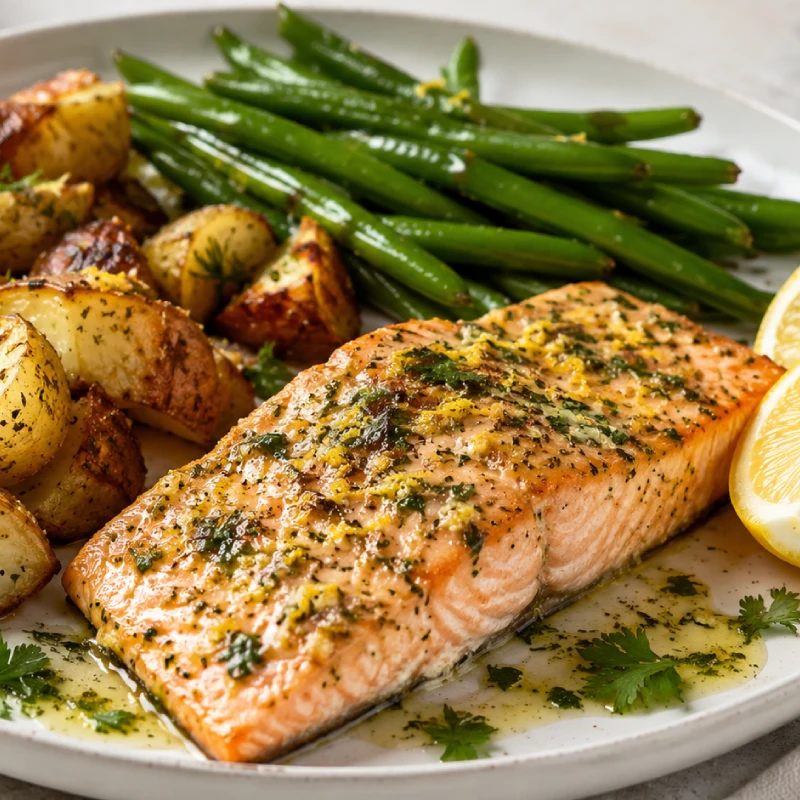
There is something wonderfully reassuring about a dinner made from simple ingredients: golden roasted potatoes, tender salmon, crisp green beans and a bright squeeze of lemon.
This Low FODMAP lemon herb salmon is exactly that kind of meal. It is uncomplicated enough for a busy weeknight but feels special enough to make when you want a proper sit-down dinner.
Better still, we are going to build it as a genuinely balanced meal.
This recipe has been designed to follow the principles of the Harvard Healthy Eating Plate, with plenty of vegetables, a satisfying portion of carbohydrate, quality protein from salmon and extra-virgin olive oil as the main added fat.
Each serving is also designed to provide at least 30 g of protein and approximately 10 g or more of fibre, while keeping the ingredients and portions appropriate for a Low FODMAP meal.
And there is no need for garlic or onion to make it delicious.
Lemon zest, fresh herbs, Dijon mustard and garlic-infused olive oil give the salmon plenty of flavour without relying on the ingredients that so often cause problems in conventional marinades and seasoning mixes.
If you are following a Low FODMAP Diet for IBS or digestive symptoms and are beginning to feel that dinner has become repetitive, keep this recipe nearby. Simple food can still be colourful, nourishing and genuinely enjoyable.
Table of Contents
Why You’ll Love This Low FODMAP Salmon Recipe
Salmon, potatoes and vegetables are already a lovely combination. With a few thoughtful adjustments, they can also make a very practical Low FODMAP meal.
This recipe gives you:
- more than 30 g of protein per serving;
- approximately 10 g or more of fibre;
- omega-3-rich salmon;
- a generous amount of vegetables;
- satisfying roasted potatoes;
- extra-virgin olive oil as the primary added fat;
- no onion or whole garlic;
- plenty of flavour from lemon and fresh herbs;
- one straightforward dinner suitable for beginner cooks.
It is also naturally gluten-free when you choose a gluten-free Dijon mustard.
Most importantly, it does not feel like a collection of substitutions. It is simply a good salmon dinner that happens to have been designed carefully for someone following a Low FODMAP Diet.
How This Meal Fits the Harvard Healthy Eating Plate
The Harvard Healthy Eating Plate provides a useful visual framework for creating balanced meals. Broadly, the plate encourages us to make approximately half our meal vegetables and fruits, one quarter healthy protein and one quarter whole grains, alongside healthy plant oils and water.
There is one small adaptation worth explaining here.
What About the Potatoes?
Potatoes are not classified as whole grains in the Harvard Healthy Eating Plate. Harvard actually places potatoes differently from other vegetables because of their effect on blood glucose.
So I would not tell you that salmon, potatoes and green beans automatically create a perfect Harvard plate. That would be oversimplifying the model.
Instead, we can take the principles of the Harvard plate and use them intelligently.
For this meal, we keep the potato portion moderate and make the vegetable portion generous. Green beans are accompanied by carrots and baby spinach, giving us substantially more non-starchy vegetables than you might find in a traditional salmon-and-potatoes dinner.
If you want to follow the Harvard plate more literally, you can replace part of the potatoes with a Low FODMAP portion of quinoa or brown rice.
For an everyday balanced meal, however, this combination gives us a useful structure:
- approximately half the plate: green beans, carrots and spinach;
- approximately one quarter: lemon-herb salmon;
- approximately one quarter: roasted potatoes;
- healthy fat: extra-virgin olive oil and the naturally occurring fats in salmon.
Simple, colourful and satisfying.
A High-Protein Low FODMAP Dinner
Salmon makes reaching our protein target relatively easy.
This recipe uses approximately 170 g of raw salmon per person, which should comfortably provide more than the requested 30 g of protein per serving.
Plain fish itself does not contain FODMAP carbohydrates. Where you need to be more careful is with everything added to it.
Pre-marinated salmon, spice mixes and bottled sauces may contain ingredients such as:
- garlic;
- onion;
- honey;
- high-FODMAP sweeteners;
- garlic or onion powders.
That is why we are making our own very simple lemon and herb marinade.
You know exactly what goes into it, and it takes only a couple of minutes to prepare.
Lemon Herb Salmon with Roasted Potatoes and Green Beans
Serves: 4
Prep time: 15 minutes
Cooking time: 35–40 minutes
Total time: approximately 50 minutes
Difficulty: Easy
Meal prep friendly: Yes, although the salmon is best freshly cooked
Ingredients
For the roasted potatoes
- 800 g baby potatoes, quartered
- 1½ tablespoons extra-virgin olive oil
- 1 teaspoon dried rosemary
- ½ teaspoon smoked paprika
- ½ teaspoon salt
- Freshly ground black pepper
For the lemon herb salmon
- 4 salmon fillets, approximately 170 g each
- 1½ tablespoons garlic-infused extra-virgin olive oil
- Zest of 1 lemon
- 2 tablespoons fresh lemon juice
- 1 teaspoon Dijon mustard, checking that it contains no onion or garlic
- 2 tablespoons finely chopped fresh parsley
- 1 tablespoon chopped fresh chives
- ½ teaspoon dried oregano
- ½ teaspoon salt
- Freshly ground black pepper
For the vegetables
- 300 g green beans, trimmed
- 400 g carrots, sliced into batons
- 200 g baby spinach
- 1 tablespoon extra-virgin olive oil
- 1 tablespoon fresh lemon juice
- Salt and black pepper, to taste
To increase the fibre
- 60 g chia seeds, approximately 15 g per serving
- 4 tablespoons water
- 2 tablespoons lemon juice
- 1 tablespoon garlic-infused olive oil
- Pinch of salt
Optional garnish
- Fresh parsley
- Fresh chives
- Lemon wedges
- Green spring onion tops, finely sliced
Low FODMAP note: FODMAP content depends on portion size, and testing information can change. Check current serving information in the Monash University FODMAP app if you are following the restriction phase closely.
Monash University’s 2025 update is a useful reminder of this: several foods were retested and their FODMAP ratings or identified FODMAP groups changed.
How to Make Low FODMAP Lemon Herb Salmon
Step 1: Preheat the Oven
Preheat your oven to 200°C fan / 220°C conventional.
Line a large baking tray with baking paper or use a shallow roasting dish.
If possible, give the potatoes plenty of room. Potatoes crowded together tend to steam rather than become beautifully golden.
Step 2: Start the Potatoes
Wash the baby potatoes and cut them into quarters. If yours are particularly small, halves are fine.
Place them on the baking tray and add the olive oil, rosemary, smoked paprika, salt and black pepper.
Toss everything together until the potatoes are evenly coated.
Arrange them cut-side down where possible.
Roast for 20 minutes before adding the other ingredients.
Starting the potatoes first is important because they need considerably longer to cook than the salmon.
Step 3: Prepare the Lemon Herb Marinade
While the potatoes are roasting, prepare your salmon.
In a small bowl, combine:
- garlic-infused olive oil;
- lemon zest;
- lemon juice;
- Dijon mustard;
- parsley;
- chives;
- oregano;
- salt;
- black pepper.
Stir until combined.
Place the salmon fillets on a plate and spoon the mixture over the top and sides.
You do not need to leave the salmon marinating for hours. The lemon and herbs provide plenty of flavour with a short resting time while the potatoes cook.
Step 4: Prepare the Carrots and Green Beans
Slice the carrots into relatively thin batons so they cook at approximately the same rate as the green beans.
Once the potatoes have roasted for 20 minutes, carefully remove the tray from the oven.
Turn the potatoes.
Add the carrots to the tray with a small drizzle of olive oil and return everything to the oven for approximately 8 minutes.
We add the green beans later so that they remain bright and slightly crisp rather than becoming soft and wrinkled.
Step 5: Add the Salmon and Green Beans
Remove the tray again.
Push the potatoes and carrots towards the sides and place the salmon fillets in the centre, skin-side down if they have skin.
Scatter the green beans around the salmon.
Return the tray to the oven.
Bake for approximately 10–14 minutes, depending on the thickness of your salmon fillets and how well done you prefer them.
The salmon should flake easily when gently pressed with a fork, but avoid cooking it for longer than necessary. Overcooked salmon becomes dry very quickly.
For food safety, use appropriate local guidance for cooking fish, particularly if serving people who are pregnant, older, immunocompromised or otherwise at higher risk from foodborne illness.
Step 6: Wilt the Spinach
While the salmon finishes cooking, place the spinach in a large frying pan over medium heat with a splash of water.
Cook for just 1–2 minutes until wilted.
Alternatively, you can place the spinach underneath the hot roasted vegetables when serving. The residual heat will gently soften it.
Add a squeeze of lemon and a small pinch of salt.
Step 7: Make the Lemon-Chia Dressing
Combine the chia seeds, water, lemon juice, garlic-infused olive oil and a pinch of salt.
Stir thoroughly and leave for around 5 minutes.
The chia will absorb some of the liquid and create a spoonable dressing.
If it becomes too thick, simply add another tablespoon of water.
Why add chia to a salmon dinner?
Because it is an easy way to increase the fibre content without making the plate enormous. Together with the potatoes, carrots, green beans and spinach, it helps us reach our target of approximately 10 g or more of fibre per serving.
Step 8: Build Your Plate
Divide everything between four plates.
For each person, serve approximately:
- 1 salmon fillet;
- 200 g roasted potatoes;
- a generous portion of carrots;
- green beans;
- wilted spinach;
- lemon-chia dressing.
Try to let the colourful non-starchy vegetables occupy close to half of the visual space on your plate.
Spoon a little of the lemon-chia dressing over the vegetables or salmon and finish with fresh parsley, chives and a wedge of lemon.
Dinner is ready.
Why Garlic-Infused Oil Works So Well
One of the first questions people ask when starting a Low FODMAP Diet is:
“But how am I supposed to cook without garlic?”
It is understandable. Garlic appears everywhere.
Fortunately, garlic-infused oil can become one of the most useful ingredients in your Low FODMAP kitchen.
Garlic itself is rich in fructans. Monash University’s 2025 reintroduction update continues to list garlic specifically within the fructan-garlic reintroduction category, with no change noted for the reintroduction food.
Using a suitable garlic-infused oil allows us to bring that familiar savoury flavour to the salmon without adding garlic pieces to the recipe.
Be careful with garlic-flavoured sauces or dressings, though. They are not necessarily equivalent to infused oil and may contain actual garlic.
Always read the ingredient list.
How We Reach 30 g of Protein and 10 g of Fibre
A nutritionally balanced Low FODMAP meal needs to be about more than simply avoiding FODMAPs.
For this recipe, I wanted each serving to have two specific nutritional targets:
at least 30 g of protein and approximately 10 g of fibre.
Protein
The salmon does most of the work here.
A 170 g raw salmon fillet should comfortably take the finished meal beyond 30 g protein per serving.
There will also be smaller contributions from the potatoes, vegetables and chia seeds.
Fibre
Fibre is distributed throughout the meal rather than coming from one enormous serving of a single food.
Each plate contains fibre from:
- potatoes;
- green beans;
- carrots;
- spinach;
- chia seeds.
Using approximately 15 g chia seeds per serving provides a particularly useful fibre boost.
The exact nutritional values will vary according to the salmon fillets, vegetable sizes and specific products you use, so these figures should be treated as estimates rather than laboratory-tested nutritional information.
Why Fibre Matters on a Low FODMAP Diet
Fibre deserves a little extra attention when following a Low FODMAP Diet.
When someone removes foods because they are high in FODMAPs, they can accidentally remove some of their regular sources of fibre at the same time.
The solution is not to eat huge amounts of fibre overnight.
For a sensitive digestive system, that can be quite uncomfortable.
Instead, think about diversity and gradual increases.
This salmon dinner obtains fibre from several different plant foods, allowing us to create a higher-fibre meal without depending on one very large serving.
If your current diet is relatively low in fibre, you do not need to jump immediately to the full chia portion. Begin with an amount that feels comfortable and increase gradually.
Adequate fluid intake matters too.
Your gut does not award prizes for reaching a particular fibre number in one day. Consistency and tolerance matter more.
Is Salmon Low FODMAP?
Plain salmon is naturally free from the fermentable carbohydrates we call FODMAPs.
This makes salmon an excellent protein base when constructing a Low FODMAP meal.
But there is an important distinction between plain salmon and prepared salmon.
A pre-seasoned fillet from the supermarket may contain garlic, onion, marinades or sauces. Similarly, salmon served in restaurants may have been marinated in ingredients you cannot see.
At home, the solution is wonderfully straightforward.
Buy plain salmon and season it yourself.
Lemon, fresh herbs, black pepper, mustard and infused oils give you plenty of flavour without requiring a complicated ingredient list.
Are Green Beans Low FODMAP?
Green beans can be incorporated into Low FODMAP eating in appropriate portions.
As with many plant foods, portion size matters.
This is particularly important because Low FODMAP is not a binary system where every food is simply “safe” or “unsafe”. The amount eaten at one sitting can change the FODMAP load.
This recipe distributes the green beans between four people and combines them with carrots and spinach rather than trying to obtain the entire vegetable portion from one food.
That variety is helpful nutritionally as well as visually.
Low FODMAP Doesn’t Mean Vegetable-Free
This deserves saying because it is an easy trap to fall into.
A Low FODMAP Diet should not automatically become a diet of:
chicken + rice
or
fish + potatoes.
Vegetables still matter.
The challenge is learning which vegetables, and which portions, fit into your current stage of the diet.
Monash University’s 2025 reintroduction update demonstrates just how nuanced this can be. For example, the updated material shows changes to the classifications of vegetables including beetroot, Brussels sprouts, Savoy cabbage, cauliflower, celery, green peas and sugar snap peas.
This is also why old Low FODMAP food lists floating around online can be misleading.
Food testing evolves.
Whenever portion sizes really matter — particularly during the restriction and reintroduction phases — use the current Monash FODMAP app rather than relying solely on an old printable list.
Can I Meal Prep This Salmon Dinner?
Yes, although salmon is one of those foods I personally prefer freshly cooked when possible.
You can make weeknight dinner much faster by preparing the other components in advance.
Prepare Ahead
You can:
- wash and cut the potatoes;
- trim the green beans;
- slice the carrots;
- wash the spinach;
- chop the herbs;
- mix the dry seasonings;
- prepare the chia dressing;
- portion your salmon.
Then, when dinner time arrives, you mainly need to roast and assemble.
If you cook the entire meal ahead, cool it promptly and refrigerate it in suitable airtight containers according to local food-safety recommendations.
When reheating salmon, use gentle heat if possible. High heat tends to dry it out.
Easy Low FODMAP Variations
Once you have made this recipe once, it becomes very easy to adapt.
Try Different Herbs
Parsley and chives are mild and fresh, but you can experiment with other herbs.
Try:
- dill;
- coriander;
- basil;
- thyme;
- rosemary;
- oregano.
Dill is particularly lovely with salmon and lemon.
Add a Little Heat
If chilli agrees with you personally, add a pinch of chilli flakes to the salmon marinade.
Remember that something can be Low FODMAP and still trigger digestive symptoms for an individual. FODMAP content is only one piece of the digestive-health puzzle.
Swap Some of the Potatoes for a Whole Grain
If you would like the recipe to align more literally with the Harvard Healthy Eating Plate, replace part or all of the potato portion with an appropriate serving of:
- brown rice;
- quinoa.
This gives you a whole-grain quarter of the plate while maintaining the salmon as your protein and the colourful vegetables as approximately half of the meal.
Low FODMAP Reintroduction: Why Personalisation Matters
The strict Low FODMAP phase is not supposed to become an endlessly restrictive way of eating.
After an appropriate restriction period, reintroduction helps identify which FODMAP groups you personally tolerate and in what quantities.
And those distinctions can be surprisingly specific.
The Monash University 2025 reintroduction update separates challenges into categories including:
- lactose;
- sorbitol;
- mannitol;
- fructose;
- GOS;
- fructan from grain foods;
- fructan from vegetables and fruit;
- fructan from garlic;
- fructan from onion;
- fructose + sorbitol;
- fructan + GOS.
Garlic and onion even remain separate fructan challenges in the updated material.
That is a useful reminder that the ultimate goal is not simply to accumulate a long list of foods you avoid.
It is to understand your tolerance.
If you are struggling with reintroduction or find yourself becoming increasingly afraid to add foods back, working with a FODMAP-trained registered dietitian can be enormously helpful.
A Simple Low FODMAP Dinner That Still Feels Complete
There is no reason a digestive-friendly dinner needs to look beige or feel restrictive.
On this plate you have golden potatoes, pink salmon, bright green vegetables, sweet roasted carrots and fresh herbs, all brought together with lemon and garlic-infused olive oil.
You also have 30+ g of protein and around 10+ g of fibre per serving, with a structure inspired by the Harvard Healthy Eating Plate.
And perhaps most importantly, you have a dinner that is realistic.
No complicated sauces. No twenty-ingredient marinade. No spending an hour searching for specialist ingredients.
Just good food, prepared thoughtfully.
CTA: Save this Low FODMAP lemon herb salmon for your next weeknight dinner, and prepare the vegetables ahead of time to make cooking even easier.
Suggested internal links:
- Low FODMAP Dinner Recipes for Beginners
- How to Get Enough Fibre on a Low FODMAP Diet
- Low FODMAP Meal Prep Guide
- Low FODMAP Garlic and Onion Alternatives
- How to Reintroduce FODMAPs
- High-Protein Low FODMAP Recipes
Recommended schema: Recipe + Article + FAQPage. If the article is published on a dietitian, nutritionist or clinic website with an eligible physical business, LocalBusiness schema can also be implemented at site level.
Frequently Asked Questions
Is salmon Low FODMAP?
Yes. Plain salmon does not contain FODMAP carbohydrates, making it a very useful protein for Low FODMAP meals. Be more careful with pre-marinated salmon, sauces and seasoning mixes, which may contain onion or garlic.
Can I eat potatoes on a Low FODMAP Diet?
Plain potatoes can be incorporated into a Low FODMAP meal. What you add to them matters too, so this recipe uses simple olive oil, herbs and spices rather than seasoning blends that may contain onion or garlic.
Does this recipe provide at least 30 g of protein?
Yes. Each serving contains approximately 170 g of raw salmon, which is designed to comfortably provide more than 30 g of protein in the complete meal. Exact values will vary according to the salmon and other ingredients you use.
How does this recipe reach 10 g of fibre?
The fibre is spread across several ingredients rather than coming from one source. Potatoes, carrots, green beans, spinach and chia seeds all contribute, with the 15 g chia portion providing an additional fibre boost.
Can I make the recipe without chia seeds?
Yes, but the finished meal may no longer reach the target of approximately 10 g fibre per serving. If you are adding chia specifically to increase your fibre intake, you can also start with a smaller amount and increase gradually according to tolerance.
Can I use frozen green beans?
Yes. Frozen vegetables can be extremely convenient. Cook them according to the packet instructions and check current Low FODMAP serving guidance for the portion you intend to eat.
Why does this recipe use garlic-infused olive oil?
Garlic itself is high in fructans. Garlic remains specifically identified as the challenge food for the fructan-garlic category in Monash University’s 2025 reintroduction update. Garlic-infused oil is therefore a useful way to bring familiar garlic flavour into a Low FODMAP recipe without adding pieces of garlic.
Can I use garlic powder instead?
I would not use garlic powder during the Low FODMAP restriction phase. Unlike an appropriate garlic-infused oil, garlic powder contains the garlic itself and therefore its fructans.
Is this meal suitable for IBS?
It has been designed as a Low FODMAP meal, an approach commonly used as part of dietary management for IBS. But IBS is highly individual, and a food being Low FODMAP does not guarantee that every person will tolerate it. Portion size, fibre intake, fat, chilli, meal size and individual sensitivities can all influence symptoms.
Can I make this recipe ahead of time?
Yes. You can prepare the vegetables and dressing ahead, and you can cook the complete meal for meal prep if needed. Salmon is usually nicest freshly cooked, though, so an excellent compromise is to prep everything else beforehand and cook the fish just before eating.
Can I replace the salmon with chicken?
Absolutely. Plain chicken is another useful Low FODMAP protein. Adjust the cooking time appropriately and make sure the chicken is thoroughly cooked before serving.
Do I need to stay Low FODMAP forever?
The restrictive stage of the Low FODMAP Diet is not intended to become unnecessarily permanent. Reintroduction and personalisation are important parts of the process. Monash University’s 2025 update provides specific challenge foods across the different FODMAP categories, highlighting the purpose of identifying individual tolerance rather than avoiding every FODMAP indefinitely.