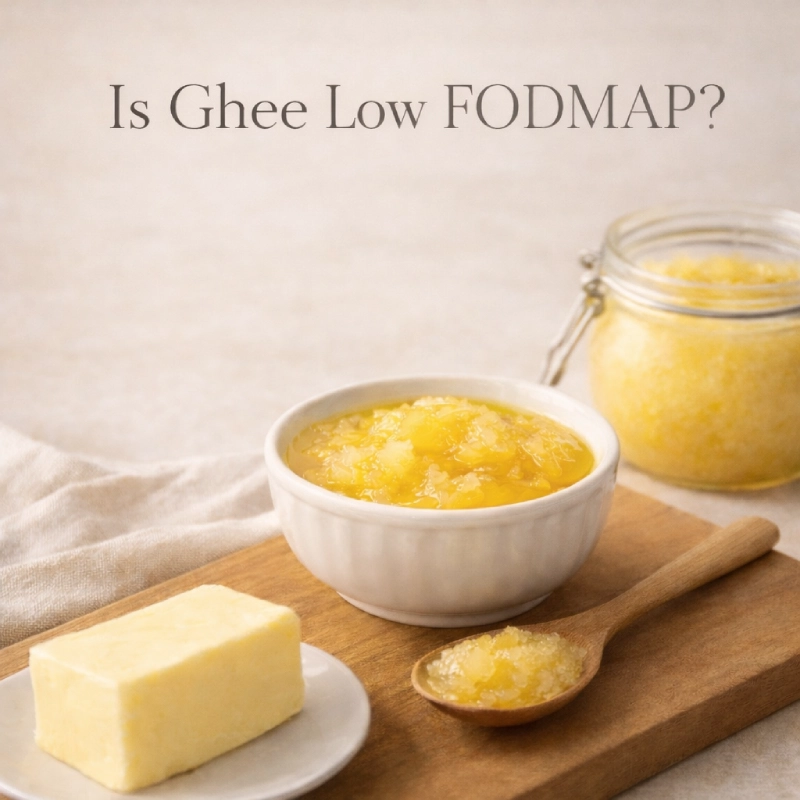
If you’re navigating the Low FODMAP Diet, you may be asking: is ghee low FODMAP?
It often appears in “gut-friendly” recipes, Ayurvedic cooking, and dairy-free lists. But when you’re living with IBS or SIBO, you need clarity, not trends.
Let’s answer gently and precisely:
Yes, ghee is low FODMAP in typical serving sizes and is generally well tolerated in IBS.
But as always, the full picture matters. In this article, we’ll explore:
- Why ghee is low FODMAP
- How it compares to butter
- Whether it’s safe during elimination
- Portion guidance
- When it might still cause symptoms
- Practical ways to use it confidently
Take a breath. We’ll make this simple.
Table of Contents
What Is Ghee?
Ghee is a type of clarified butter traditionally used in Indian and Middle Eastern cooking.
It’s made by:
- Heating butter slowly
- Allowing water to evaporate
- Removing milk solids (which contain lactose and casein)
- Leaving behind pure butterfat
The result is:
- Golden, aromatic fat
- Higher smoke point than butter
- Virtually no lactose
And that last point is what makes it relevant for IBS.
Is Ghee Low FODMAP?
The Short Answer
Yes, ghee is low FODMAP because it contains negligible lactose.
Why Ghee Is Considered Low FODMAP
The only FODMAP naturally present in dairy is lactose (a disaccharide).
Since ghee has had its milk solids removed, it contains:
- Almost no lactose
- Almost no dairy protein
- Pure fat
Because FODMAPs are carbohydrates (not fats) pure fats do not contain FODMAPs.
That’s why, if you’re wondering is ghee low FODMAP? the answer is reassuringly yes.
Ghee and the Low FODMAP Diet Phases
Let’s break this down by phase.
During the Elimination Phase
Ghee is suitable during elimination.
Unlike milk or yoghurt, it does not contain enough lactose to trigger fermentation in most people with IBS.
The Low FODMAP Diet, developed by researchers at Monash University, focuses on reducing fermentable carbohydrates, not fats.
Since ghee contains no fermentable carbohydrates, it fits comfortably within elimination guidelines.
During Reintroduction
Ghee is not used as a lactose reintroduction food.
According to recent updates from Monash University , lactose challenges are conducted using foods that contain measurable lactose amounts, such as:
- Cow’s milk
- Greek yoghurt
Ghee simply does not contain enough lactose to test tolerance meaningfully.
How Much Ghee Is Low FODMAP?
Because ghee is almost pure fat, it remains low FODMAP even at larger portions.
However (and this is important) tolerance is not only about FODMAPs.
Recommended Practical Serving
For most people with IBS:
- 1 tablespoon (around 14g) is a sensible serving size.
You could technically tolerate more from a FODMAP perspective, but large amounts of fat may still trigger digestive symptoms in some individuals.
Butter vs Ghee: Which Is Better for IBS?
This is a very common question.
Butter
- Contains small amounts of lactose
- Low FODMAP in 1 tablespoon servings
- Contains trace dairy proteins
Ghee
- Virtually lactose-free
- Lower in dairy proteins
- Slightly higher smoke point
So, Which Should You Choose?
If you tolerate butter, there is no medical reason to switch to ghee.
But ghee may be helpful if:
- You are highly sensitive to lactose
- You suspect dairy protein sensitivity
- You prefer its flavour
- You want a higher smoke point for cooking
Remember: IBS is individual. What feels soothing for one gut may not for another.
Why Some People Still React to Ghee
Even though ghee is low FODMAP, symptoms can still occur.
Let’s explore why without fear, just understanding.
1. High Fat Content
Fat stimulates:
- Bile release
- The gastrocolic reflex
- Intestinal motility
In people with IBS-D, high-fat meals can:
- Increase urgency
- Worsen loose stools
This is not a FODMAP reaction; it’s a physiological fat response.
2. Portion Creep
While ghee is FODMAP-safe, eating it in very large amounts may:
- Feel heavy
- Cause discomfort
- Slow digestion
Gentle moderation supports gut comfort.
3. Co-existing Conditions
If you have:
- SIBO
- Gallbladder issues
- Fat malabsorption
- Pancreatic insufficiency
High-fat foods may worsen symptoms.
This is why personal context always matters.
Is Ghee Dairy-Free?
Technically, ghee is derived from dairy, but it contains almost no lactose or casein.
Some people with severe milk protein allergy should avoid it. But most people with lactose intolerance tolerate it well.
IBS and lactose intolerance are different conditions, though they can overlap.
If your symptoms are clearly lactose-driven, ghee is often a comfortable option.
Is Ghee Healthier Than Butter?
Let’s approach this carefully and honestly.
Both ghee and butter:
- Contain saturated fat
- Provide fat-soluble vitamins
- Are calorie-dense
Ghee does not magically “heal the gut” or “cure IBS”.
There is no strong evidence that ghee has special digestive benefits beyond its low lactose content.
The advantage of ghee in IBS is primarily:
Its lack of fermentable carbohydrates.
Balance remains essential. UK dietary guidelines still recommend moderation with saturated fats.
Cooking with Ghee on a Low FODMAP Diet
Ghee can be a wonderful addition to low FODMAP cooking.
Here are some practical ideas:
- Sauté courgettes and carrots
- Fry eggs
- Roast parsnips or potatoes
- Add a spoonful to rice
- Use as a base for low FODMAP curries (without onion/garlic)
Because of its higher smoke point, ghee works beautifully for:
- Stir-fries
- Pan-searing
- Roasting at higher temperatures
It also carries spices well, making it helpful when flavour feels limited during elimination.
Emotional Reassurance: You Don’t Have to Fear Fats
Many people with IBS begin to fear fats, especially if they’ve had urgent episodes after rich meals.
But restriction isn’t always the answer.
Understanding the difference between:
- A FODMAP trigger
- A fat sensitivity
- A portion issue
… gives you control.
Ghee is not something you need to eliminate automatically. Instead, observe your body kindly.
Common Myths About Ghee and IBS
Let’s gently clear the air.
“Ghee cures IBS.”
No food cures IBS. Management is multi-factorial and individual.
“If butter triggers me, ghee will definitely be safe.”
Often true, but not guaranteed. Fat tolerance still matters.
“All dairy fats are high FODMAP.”
False. FODMAPs are carbohydrates, not fats.
Final Answer: Is Ghee Low FODMAP?
Yes, ghee is low FODMAP because it contains virtually no lactose.
It is suitable for:
- Elimination phase
- Lactose-sensitive individuals
- Most people with IBS
However:
- Large fat loads may still trigger symptoms
- Individual tolerance varies
- It should be used in moderation
If you’ve been unsure about including ghee, I hope this helps you feel calmer and clearer.
You deserve meals that feel safe and satisfying.
FAQs: Is Ghee Low FODMAP?
Is ghee low FODMAP for IBS?
Yes. Ghee contains almost no lactose, making it low FODMAP and generally well tolerated by people with IBS.
Can I use ghee during the elimination phase?
Absolutely. Ghee is suitable during elimination because it contains no fermentable carbohydrates.
How much ghee is safe on a low FODMAP diet?
Around 1 tablespoon per serving is a sensible amount. Larger amounts are still low FODMAP but may trigger symptoms due to fat content.
Is ghee better than butter for IBS?
Ghee may be better for people who are very sensitive to lactose or dairy proteins. However, many people tolerate butter just as well.
Does ghee contain lactose?
Ghee contains negligible lactose because the milk solids are removed during clarification.
If you’d like more gentle guidance on navigating fats, dairy alternatives, or the elimination phase, explore our related articles on butter, lactose-free dairy, and low FODMAP cooking swaps.
Your gut is not broken. It simply needs understanding, and you’re already taking the right steps.