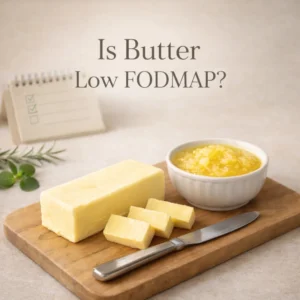
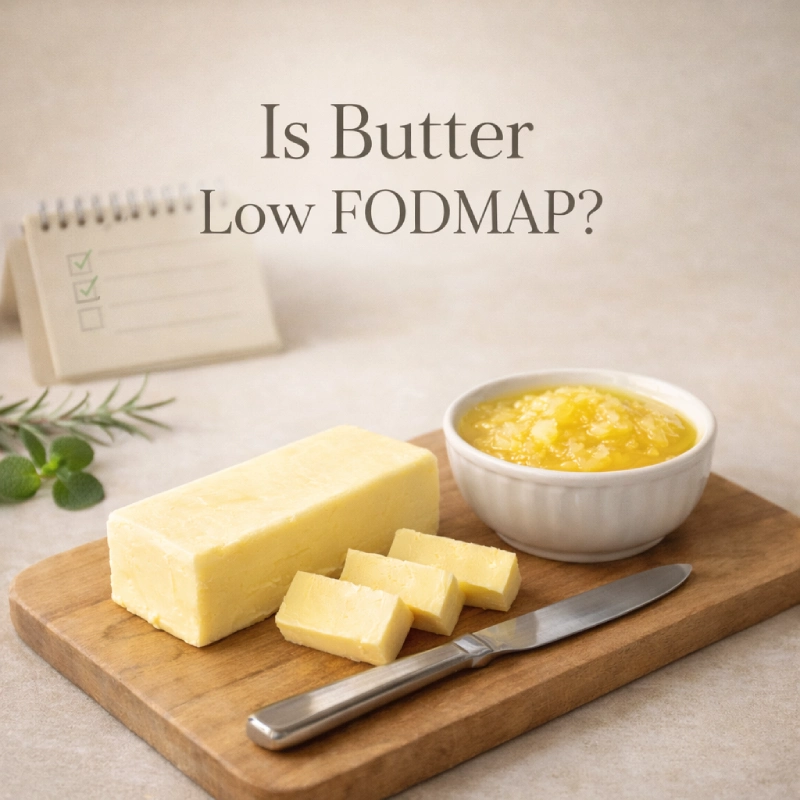
If you’re living with IBS, SIBO, or regular bloating, you’ve probably found yourself standing in the kitchen wondering: is butter low FODMAP?
It’s such a simple ingredient, and yet, when you’re navigating the Low FODMAP Diet, nothing feels simple at first.
The reassuring answer is: yes, butter is low FODMAP in typical serving sizes. But (as always with gut health) there’s a little nuance worth understanding.
In this article, we’ll explore:
- Whether butter contains lactose
- Safe serving sizes for IBS
- The difference between butter and ghee
- When butter might still trigger symptoms
- Practical tips for using butter during elimination and reintroduction
Take a deep breath. Let’s make this clear and calm together.
Table of Contents
What Does “Low FODMAP” Actually Mean?
Before answering “is butter low FODMAP?” in depth, it helps to revisit what FODMAPs are.
FODMAP stands for:
- Fermentable
- Oligosaccharides
- Disaccharides (like lactose)
- Monosaccharides (like excess fructose)
- And
- Polyols (like sorbitol and mannitol)
These are short-chain carbohydrates that can be poorly absorbed in the small intestine. In people with IBS, they may:
- Draw water into the bowel
- Ferment rapidly in the colon
- Cause gas, bloating, pain, and altered bowel habits
The Low FODMAP Diet, developed by researchers at Monash University, is designed to temporarily reduce these fermentable carbohydrates to calm symptoms.
Now let’s apply this to butter.
Is Butter Low FODMAP?
The Short Answer
Yes; butter is low FODMAP in normal serving sizes.
Why Butter Is Considered Low FODMAP
Butter is made by churning cream, which separates:
- Milk fat (the solid part we call butter)
- Buttermilk (which contains most of the lactose)
Because butter is almost entirely fat, it contains very little lactose, which is the FODMAP of concern in dairy.
A typical serving of butter (around 10–14g, or 1 tablespoon) contains only trace amounts of lactose, far below the threshold that would trigger symptoms for most people with IBS.
So if you’re wondering again: is butter low FODMAP? the answer remains yes, in sensible portions.
Does Butter Contain Lactose?
This is where confusion often arises.
Butter is made from cream, and cream contains lactose. However:
- During churning, most of the lactose stays in the liquid portion.
- The final butter contains only tiny residual amounts.
To put this into perspective:
- A glass of milk may contain 10–12g lactose.
- A tablespoon of butter contains a fraction of a gram.
For most people with lactose sensitivity, that amount is negligible.
However, remember something important:
IBS is not the same as lactose intolerance, though they can overlap.
If you have confirmed lactose intolerance, butter is usually tolerated in small amounts, but individual thresholds vary.
Butter vs Ghee: Which Is Better for IBS?
Many people ask whether ghee is safer than butter.
What Is Ghee?
Ghee is clarified butter. It’s made by heating butter and removing:
- Water
- Milk solids
- Almost all lactose and casein
What remains is pure butterfat.
Is Ghee Low FODMAP?
Yes, and even more so than butter.
Because nearly all milk solids are removed, ghee contains virtually no lactose. For people who are:
- Highly lactose sensitive
- Following strict elimination
- Concerned about dairy proteins
Ghee may feel gentler.
Should You Switch to Ghee?
Not necessarily.
If you tolerate butter well, there is no need to avoid it. Butter is low FODMAP already. But if you notice symptoms even with small amounts, ghee is a helpful alternative.
When Might Butter Still Trigger Symptoms?
Even though butter is low FODMAP, it doesn’t mean it’s perfect for everyone.
Let’s explore why.
1. Large Quantities
FODMAP status depends on serving size.
- 1 tablespoon? Generally low FODMAP.
- Half a block melted over vegetables? That’s another story.
While butter itself doesn’t become “high FODMAP,” large amounts of fat can:
- Slow gastric emptying
- Trigger gastrocolic reflex
- Exacerbate IBS-D symptoms
Sometimes it’s the fat load, not the FODMAP content, that causes trouble.
2. Dairy Protein Sensitivity
Butter contains small traces of:
- Casein
- Whey proteins
If you have a dairy protein intolerance (different from lactose intolerance), even small amounts might cause symptoms.
3. Co-existing Conditions
If you have:
- SIBO
- Gallbladder issues
- Fat malabsorption
High-fat foods (even low FODMAP ones) may worsen symptoms.
This is why we always look at the whole digestive picture, not just FODMAP content.
Is Salted or Unsalted Butter Low FODMAP?
Both salted and unsalted butter are low FODMAP.
Salt does not affect FODMAP content.
Choose based on:
- Taste preference
- Recipe requirements
- Blood pressure considerations
From a FODMAP perspective, they’re equivalent.
What About Spreadable Butter?
Here we need to be careful.
Some spreadable butters contain:
- Added milk
- Whey powder
- Inulin (a high-FODMAP fructan)
- Vegetable oils
Always check the ingredient list.
If the product is:
- Pure butter + salt → low FODMAP
- Butter blended with high-FODMAP additives → may not be suitable
When in doubt, keep it simple.
Is Butter Low FODMAP During Elimination?
Yes.
Butter is suitable during the elimination phase of the Low FODMAP Diet.
According to Monash testing principles, lactose becomes problematic above certain thresholds. Butter falls comfortably below these limits in standard servings.
During elimination:
- Stick to 1 tablespoon portions
- Avoid stacking multiple lactose-containing foods in one meal
Even though butter is low FODMAP, stacking small lactose amounts from various sources could tip you over your tolerance.
Butter During Reintroduction
Butter is not used as a lactose reintroduction food.
Why?
Because it doesn’t contain enough lactose to test tolerance properly.
As shown in recent updates from Monash University’s reintroduction guidance , lactose challenges typically use:
- Cow’s milk
- Greek yoghurt
These provide sufficient lactose to meaningfully assess tolerance.
Butter is simply too low in lactose to function as a test food.
Practical Ways to Use Butter on a Low FODMAP Diet
If you tolerate butter, here are gentle ways to include it:
- Spread thinly on low FODMAP toast
- Melted over roasted carrots or courgettes
- Used to sauté low FODMAP greens
- Added to mashed potatoes (within portion limits)
- Mixed into scrambled eggs
Remember: balance is key.
Nutritional Perspective: Is Butter Healthy?
From a FODMAP standpoint, butter is safe. From a nutritional perspective, it’s important to consider moderation.
Butter contains:
- Saturated fat
- Fat-soluble vitamins (A, D, E, K)
Current UK dietary guidance recommends not overconsuming saturated fats. However, small amounts within a balanced diet are absolutely compatible with good health.
There is no need to fear butter, but equally, no need to overconsume it.
Gentleness and balance. Always.
Common Myths About Butter and IBS
Let’s clear a few misunderstandings.
“All dairy is high FODMAP.”
False. Only lactose-containing dairy is high FODMAP in larger amounts. Hard cheeses and butter are typically low.
“If I have IBS, I must avoid butter.”
Not true. Butter is low FODMAP and tolerated by most people with IBS.
“Ghee is always better.”
Not necessarily. It depends on your individual tolerance.
The Emotional Side of Food Fear
If you’ve been struggling with IBS, you may feel anxious around foods like butter.
Food fear is real. Restriction can become overwhelming.
But part of the Low FODMAP journey is re-expansion.
Butter is one of those small ingredients that reminds us:
You don’t have to eliminate everything.
You can still cook with flavour.
Your meals can still feel comforting.
And that matters deeply.
Final Verdict: Is Butter Low FODMAP?
Yes; butter is low FODMAP in typical serving sizes (around 1 tablespoon).
It contains only trace lactose and is generally well tolerated by people with IBS.
However:
- Large fat loads may trigger symptoms
- Individual tolerance always varies
- Ghee may suit very sensitive individuals
As always, listen to your body with curiosity, not fear.
FAQs: Is Butter Low FODMAP?
Is butter low FODMAP for IBS?
Yes, butter is low FODMAP in standard servings (around 1 tablespoon). It contains only trace amounts of lactose and is usually well tolerated by people with IBS.
Can I eat butter during the elimination phase?
Absolutely. Butter is suitable during the elimination phase of the Low FODMAP Diet, provided you stick to moderate portions.
Is ghee better than butter for IBS?
Ghee contains virtually no lactose, so it may be better tolerated by people who are extremely sensitive to dairy. However, most people with IBS tolerate regular butter just fine.
How much butter is safe on a low FODMAP diet?
Around 10–14 grams (1 tablespoon) per serving is considered low FODMAP. Larger amounts may not cause FODMAP issues but could trigger symptoms due to fat content.
Is salted butter low FODMAP?
Yes. Both salted and unsalted butter are low FODMAP. The salt content does not affect FODMAP levels.
If you’re navigating the Low FODMAP Diet and feeling unsure, you are not alone. Understanding foods like butter helps you build confidence; one gentle step at a time.